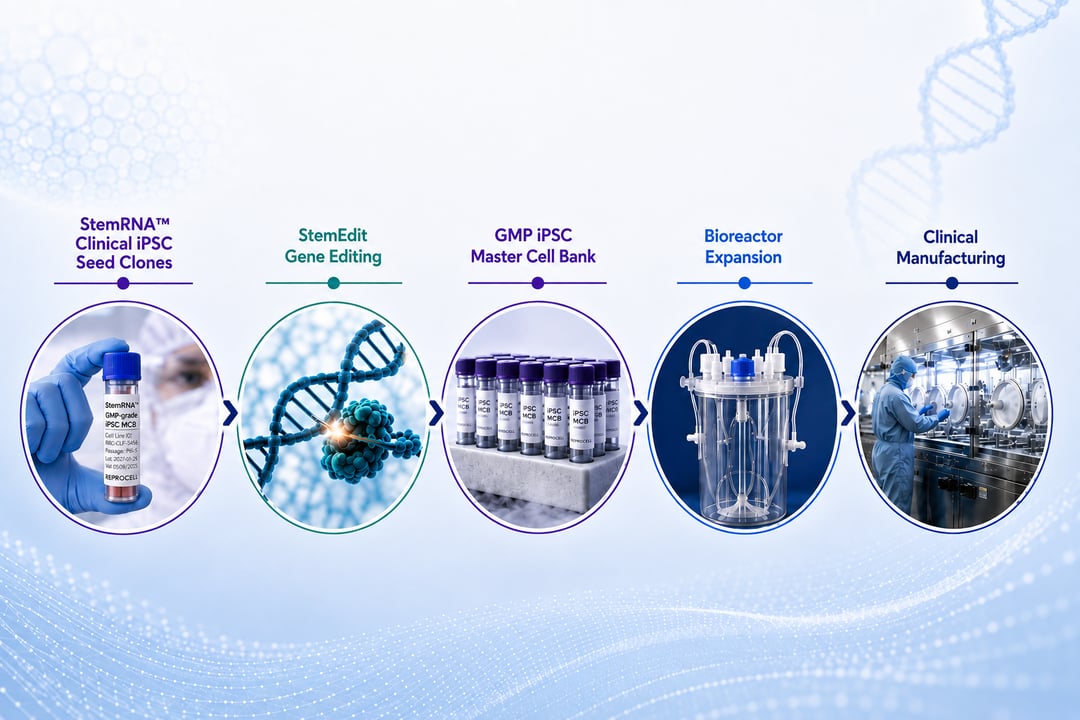
Induced pluripotent stem cells (iPSCs) have transformed regenerative medicine by providing a renewable source of human cells for disease modelling, drug discovery, and the development of next-generation cell therapies. As more iPSC-based therapies advance toward the clinic, one challenge has become increasingly clear:
How do you successfully scale from a few cells in the laboratory to the billions needed for clinical manufacturing—without compromising cell safety, functionality, consistency, or genetic integrity?
Scaling an iPSC workflow is about far more than simply growing larger numbers of cells. Every stage- from selecting the starting cell line and introducing precise genetic modifications to expanding cells under controlled manufacturing conditions must be designed to preserve cell identity, functionality, genetic integrity, and safety while ensuring quality, consistency, and regulatory compliance 1.
At REPROCELL, our iPSC platform provides a high-quality foundation for clinical development. Our StemEdit gene editing and scalable cell expansion technologies enable progression from cell line development to GMP manufacturing and clinical applications.
Key Takeaways
-
Clinical starting material: REPROCELL’s StemRNA™ Clinical iPSC platform combines clinically consented donor material, footprint-free mRNA reprogramming, and comprehensive characterisation to provide a robust starting point for clinical development aligned to FDA, EMA, and PMDA expectations.
-
Optional clinical gene editing: REPROCELL’s StemEdit platform integrates AI-designed gene editing at the Seed Clone stage, supporting custom knockouts, knock-ins, and hypoimmune engineering before progression to GMP cell banking.
-
GMP cell banking: REPROCELL converts StemRNA™ Clinical Seed Clones into a GMP Master Cell Bank (MCB), supported by rigorous quality and safety testing, providing a defined and reproducible cell source for downstream manufacturing.
-
Scalable expansion: REPROCELL provides access to ABLE Biott and BioThrust bioreactor technologies to support the transition from laboratory-scale iPSC culture to controlled, higher-volume cell expansion.
- Integrated workflow: REPROCELL brings together Clinical iPSC Seed Clones, optional StemEdit gene editing, GMP cell banking, and bioreactor technologies for scalable cell expansion, supporting progression from cell line development toward clinical manufacturing.
Building a Strong Foundation for Cell Therapy Development
The choice and quality of the starting cell source are critical to the success of downstream cell therapy development.
StemRNA™Clinical iPSC Seed Clones and Pilot Clones
REPROCELL's StemRNA™ Clinical iPSC platform features both Clinical iPSC Seed Clones and Pilot Clones, generated using a proprietary non-integrating mRNA reprogramming technology. Pilot Clones provide a cost-effective option for evaluating cell performance, optimising differentiation protocols, and establishing proof of concept, while Seed Clones are intended to support the development of clinical cell therapies. These cells are manufactured in REPROCELL's advanced cell manufacturing facility using processes designed to comply with FDA, EMA, and PMDA expectations for clinical production.
Genetic Characterization and Regulatory Support for Clinical iPSCs
Each Clinical iPSC Seed Clone, together with its donor starting material, undergoes comprehensive genetic integrity testing, including G-band karyotyping to assess chromosomal integrity and whole-genome sequencing (WGS)-based oncogenic screening to evaluate genetic variants across more than 400 cancer-related genes. In addition, all U.S. Clinical iPSC Seed Clones are supported by a Drug Master File (DMF), enabling developers to reference the DMF in support of their U.S. Investigational New Drug (IND) submissions to the FDA.
Clinical iPSC Seed Clone Supporting a U.S. Phase III Program
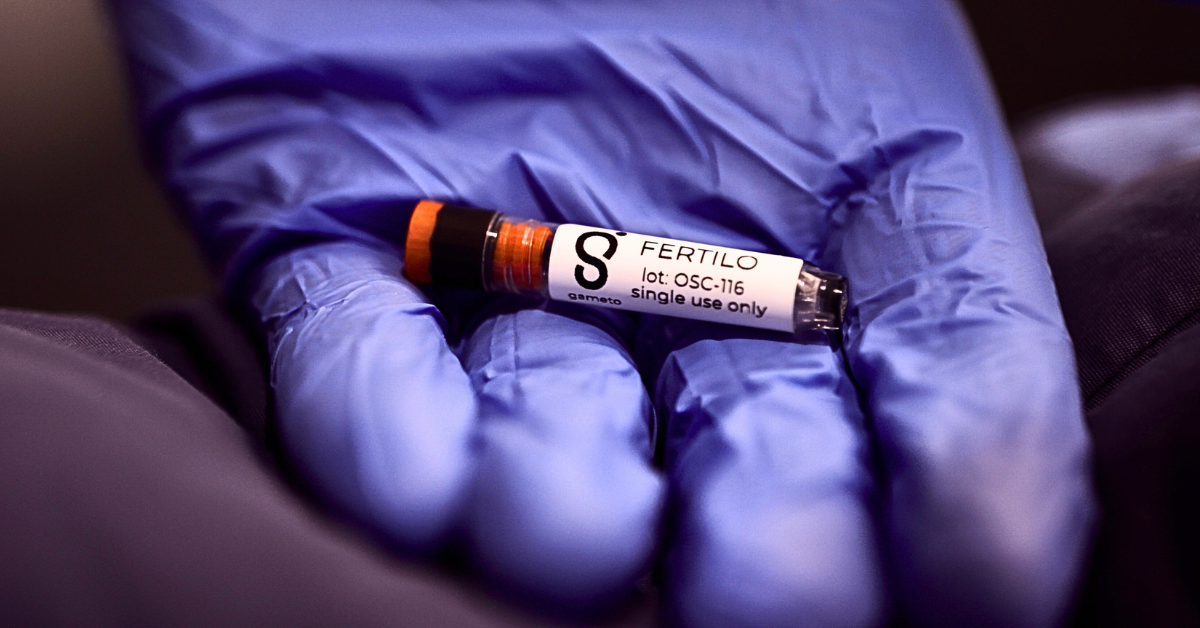
One of REPROCELL’s Clinical iPSC Seed Clones has already supported a U.S. Phase III clinical program, providing confidence in its suitability for advanced clinical development and demonstrating the maturity of the platform 2. Together, these features provide a well-characterized and clinically relevant foundation for progressing from early-stage research toward GMP manufacturing and clinical development.
StemEdit: AI-Powered Gene Editing with Flexible Licensing for Custom iPSC Engineering
For many cell therapy programs, establishing the right iPSC line is only the beginning. Cells may also need to be genetically engineered to introduce therapeutic features, improve functionality, or create a cell line tailored to a specific application.
Custom gene editing services
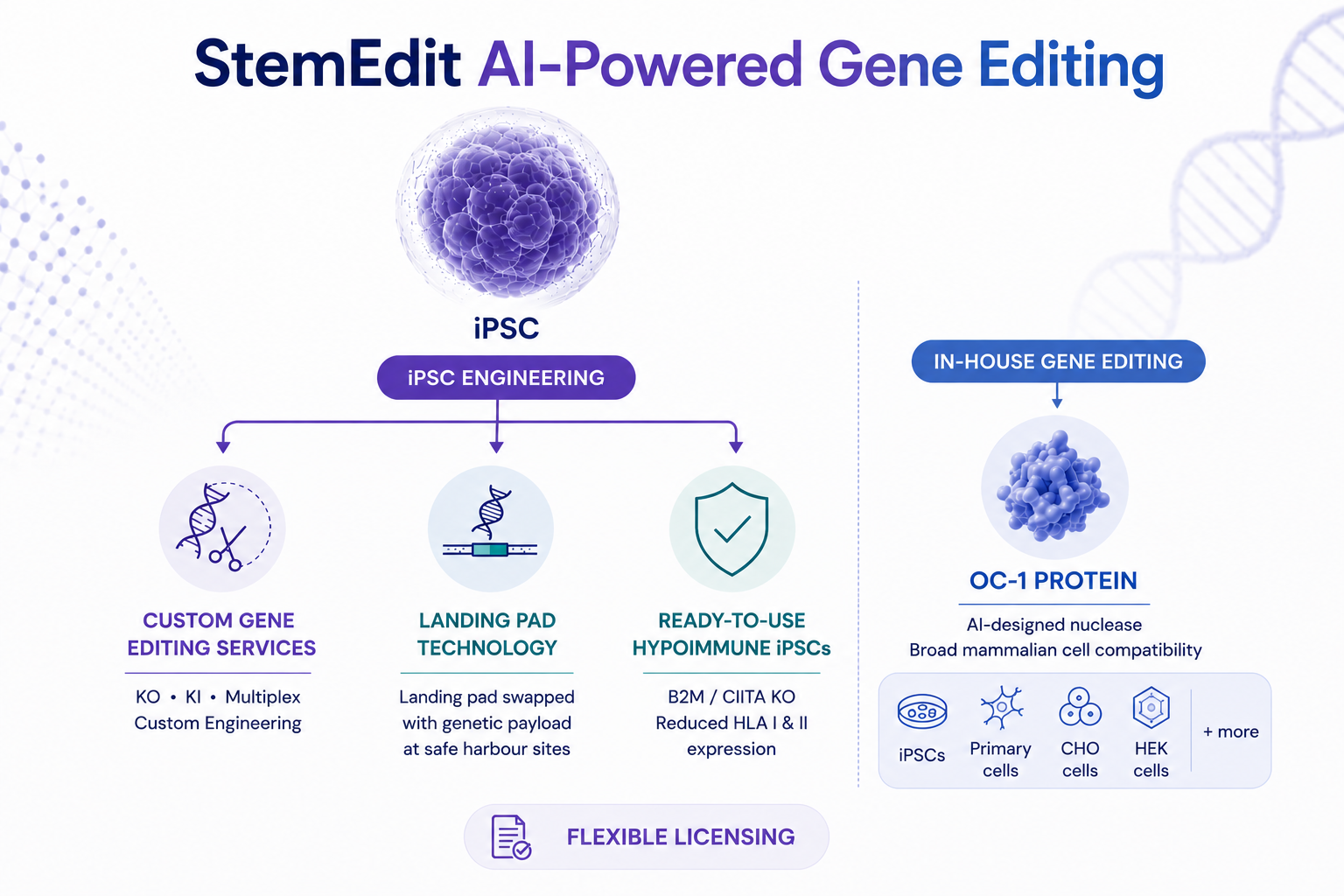
StemEdit is REPROCELL's comprehensive, AI-powered genome engineering platform, combining AI-designed gene editing technology 3 with clinically aligned iPSC expertise. The platform provides end-to-end gene editing services for iPSCs and other mammalian cells, supporting applications including targeted gene knockouts, knock-ins, multiplex editing, and hypoimmune cell engineering.
StemEdit also incorporates Landing Pad Technology for the precise integration or exchange of genetic payloads at defined genomic safe-harbour sites. This modular approach can simplify the generation of engineered cell lines while supporting stable, reproducible transgene expression.
Ready-to-use hypoimmune iPSCs
For researchers seeking ready-to-use solutions, the StemEdit platform includes hypoimmune iPSCs engineered with B2M and/or CIITA knockouts. These modifications are designed to suppress HLA class I and/or II expression, supporting the development and evaluation of hypoimmune cells for allogeneic cell therapy applications. For custom service projects and off-the-shelf hypoimmune iPSC lines, the applicable license for research, clinical, and commercial use is included, meaning customers do not require a separate or additional license.
In-house gene editing
StemEdit OC-1 Protein is also available for in-house research: an AI-designed genome-editing nuclease which is based on OpenCRISPR-1™ technology and offers high editing efficiency with reduced off-target activity, providing an alternative to conventional Cas nucleases. StemEdit OC-1 is available for research use, while commercial applications are supported through the applicable licensing framework with Profluent Bio. This allows researchers to explore AI-designed genome editing in their own laboratories while providing a pathway for programs that move toward commercial development.
GMP iPSC Master Cell Banks:
Establishing a Consistent Starting Point for Manufacturing
Once a suitable iPSC clone has been selected and, where required, genetically engineered, establishing a GMP MCB provides a controlled and well-characterised starting material for downstream manufacturing.
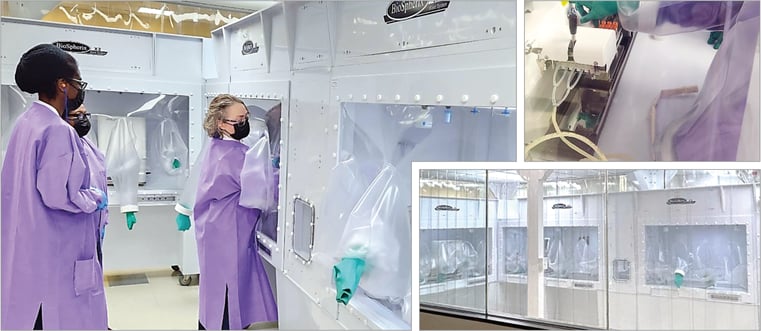
An MCB consists of cryopreserved vials generated from a defined cell population, helping ensure consistency, traceability, and reproducibility across manufacturing runs. REPROCELL manufactures GMP iPSC MCBs in Beltsville, Maryland, with European manufacturing available through its partner Histocell. Manufacturing is conducted under GMP conditions with comprehensive quality control and testing aligned with relevant regulatory expectations, including ICH Q5A and Q5D.
Developers can transition from StemRNA™ Clinical iPSC Seed Clones and StemEdit gene editing into GMP cell banking, creating a connected pathway from cell line development to clinical production. While an MCB provides a consistent and well-defined cell source, downstream bioreactor technologies enable expansion to the larger cell numbers required for clinical and commercial production while supporting consistent cell quality and performance.
Scaling iPSC Expansion with Advanced Bioreactor Technologies
With a consistent cell source established, the next challenge is producing cells at scale. Clinical applications can require hundreds of millions or even billions of cells, making traditional two-dimensional culture systems increasingly difficult and inefficient to scale 4.
Successful iPSC scale-up involves more than simply moving cells into a larger vessel. Parameters such as aggregate size, feeding strategy, nutrient and oxygen availability, cell viability and quality, and process consistency need to be evaluated as culture volumes increase. Consistent process performance must be demonstrated across scales, making scale-up a bioprocess development challenge rather than simply a change in vessel size. This requires appropriate bioreactor technology and bioprocess expertise, supported by experimental data specific to the cell line and manufacturing process.
ABLE Biott Bioreactors for 3D iPSC Expansion
Through our partnership with ABLE Biott, researchers can access scalable stirred-tank bioreactor systems designed to support efficient suspension culture while maintaining cell quality and viability. REPROCELL can also support researchers in evaluating the appropriate bioreactor configuration and planning the transition from conventional culture to 3D iPSC expansion. The relatively simple, plug-and-play system provides a practical route for researchers moving from conventional culture into 3D iPSC expansion with minimal operational complexity. The use of ABLE Biott single-use bioreactors for 3D iPSC generation and expansion has also been demonstrated in published research 5.
BioThrust Bioreactors for Advanced Scale-Up
REPROCELL also works with BioThrust, whose next-generation expansion technologies are designed to improve scalability and manufacturing efficiency for advanced cell therapy workflows 6. For these more complex applications, BioThrust provides technical guidance to help customers select an appropriate system and develop an experimental approach for their process.
An Integrated iPSC Workflow for Scalable Manufacturing
Scaling an iPSC-based programme successfully requires decisions made early in development to remain compatible with later manufacturing needs. Starting with an appropriate iPSC line, introducing any desired genetic modifications, establishing a GMP MCB, and planning for larger-scale expansion as part of a connected pathway can help reduce delays, minimise unnecessary redevelopment, and avoid changes that become more difficult as the programme progresses.
This is particularly important when moving from laboratory-scale culture to the larger cell numbers required for clinical and commercial manufacturing. Cell-line characteristics, genetic modifications, banking strategy, and expansion processes all need to work together to support consistent cell quality, functionality, and scalability. Considering these requirements from the outset can reduce the need to transfer processes between multiple providers and help maintain continuity as production increases.
By connecting StemRNA™ Clinical iPSCs, StemEdit gene editing, GMP cell banking, and bioreactor technologies for scalable expansion, REPROCELL supports developers in building a pathway designed for scale from the beginning—from cell-line development through clinical and commercial manufacturing.
Planning to scale your iPSC-based cell therapy programme?
Discuss your cell-line, gene-editing, GMP banking, and expansion requirements with our team.
References
-
Lin X and Bui T. cGMP-compliant large-scale manufacturing of human-induced pluripotent stem cells: current progress and challenges. Cytotherapy, 28. (2026).
-
Paulsen P, et al. Development of human induced pluripotent stem cell-derived ovarian support cells as a clinical-grade product for in vitro fertilization. Cell Stem Cell, 33. (2026).
-
Ruffolo JA, Nayfach S, Gallagher J, et al. Design of highly functional genome editors by modelling CRISPR-Cas sequences. Nature 645(8080):518-525, (2025).
-
Rivera-Ordaz A, Peli V, Manzini P, et al. Critical Analysis of cGMP Large-Scale Expansion Process in Bioreactors of Human Induced Pluripotent Stem Cells in the Framework of Quality by Design. BioDrugs, 35. (2021).
-
Tsukamoto M, Kawasaki T, Vemuri MC, Umezawa A, Akutsu H. A passage-free, simplified, and scalable novel method for iPSC generation in three-dimensional culture. Regenerative Therapy, 27.(2024).
- Budeus B, Kroepel C, Sevindik ZF, Buttler LF and Klein D. Upscaling: efficient generation of human lung organoids from induced pluripotent stem cells using a stirring bioreactor. Frontiers in Bioengineering and Biotechnology. 13:1684315. (2025).

About the author
Dayana Ivanova, Marketing and Business Administration, Stem Cells
Dayana combines her strong Medical Sciences background with her growing enthusiasm for digital marketing. She’s passionate about blending her scientific expertise with creative content development, making complex topics accessible and engaging. Outside of work, you’ll find Dayana staying active, traveling, and immersing herself in diverse cultures and cuisines. Connect with Dayana on LinkedIn: linkedin.com/in/dayanaivanova
Subjects we write about
- 3D Cell Culture
- Cell Culture
- Central Lab Services
- Clinical Capabilities
- Disease Modeling
- Drug Discovery
- Gene Editing
- Genomic Services
- GMP
- Human Tissue Samples
- Human Tissue Testing
- IBD
- Life Sciences
- Master Cell Banks
- Neurons
- Oligonucleotide Synthesis
- Pharmacology-AI
- Precision Medicine
- Product Catalog
- Regenerative Medicine
- Respiratory Disease
- Safety Pharmacology
- Skin Disease
- Stem Cells