What Are Off-target Effects in Gene Editing?
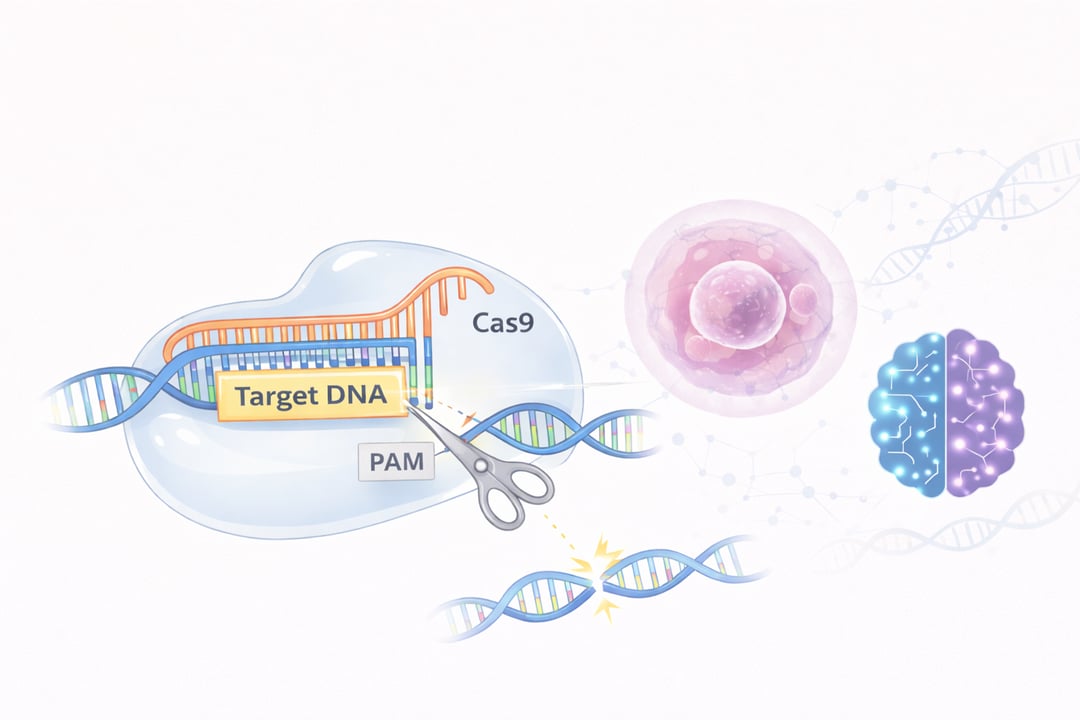
Off-target effects in gene editing refer to unintended genetic modifications occurring at genomic loci other than the intended target site. In CRISPR-based gene editing systems, these arise because the guide RNA (gRNA), which directs the system to the target DNA sequence, can also bind to DNA sequences with partial mismatches, allowing cleavage at sites with sequence similarity rather than perfect complementarity. This means the editing enzyme can sometimes cut DNA regions that are similar, but not identical, to the intended target. A key factor controlling this specificity is a short DNA segment located next to a sequence called the protospacer-adjacent motif (PAM). This region, known as the “seed region,” is the most important checkpoint for correct target recognition and is located immediately next to the PAM site. It is usually a short stretch of DNA where perfect matching is required for strong binding.
If there are mismatches in the seed region, binding and cutting are strongly reduced or fail. However, mismatches outside this region are often tolerated, which can still allow unintended binding and cutting at similar DNA sites (Figure 1).
These off-target effects can include small insertions or deletions (indels), as well as larger structural changes such as deletions, inversions, or translocations, highlighting that off-target effects represent a spectrum of genomic perturbations rather than isolated errors 1, 2.
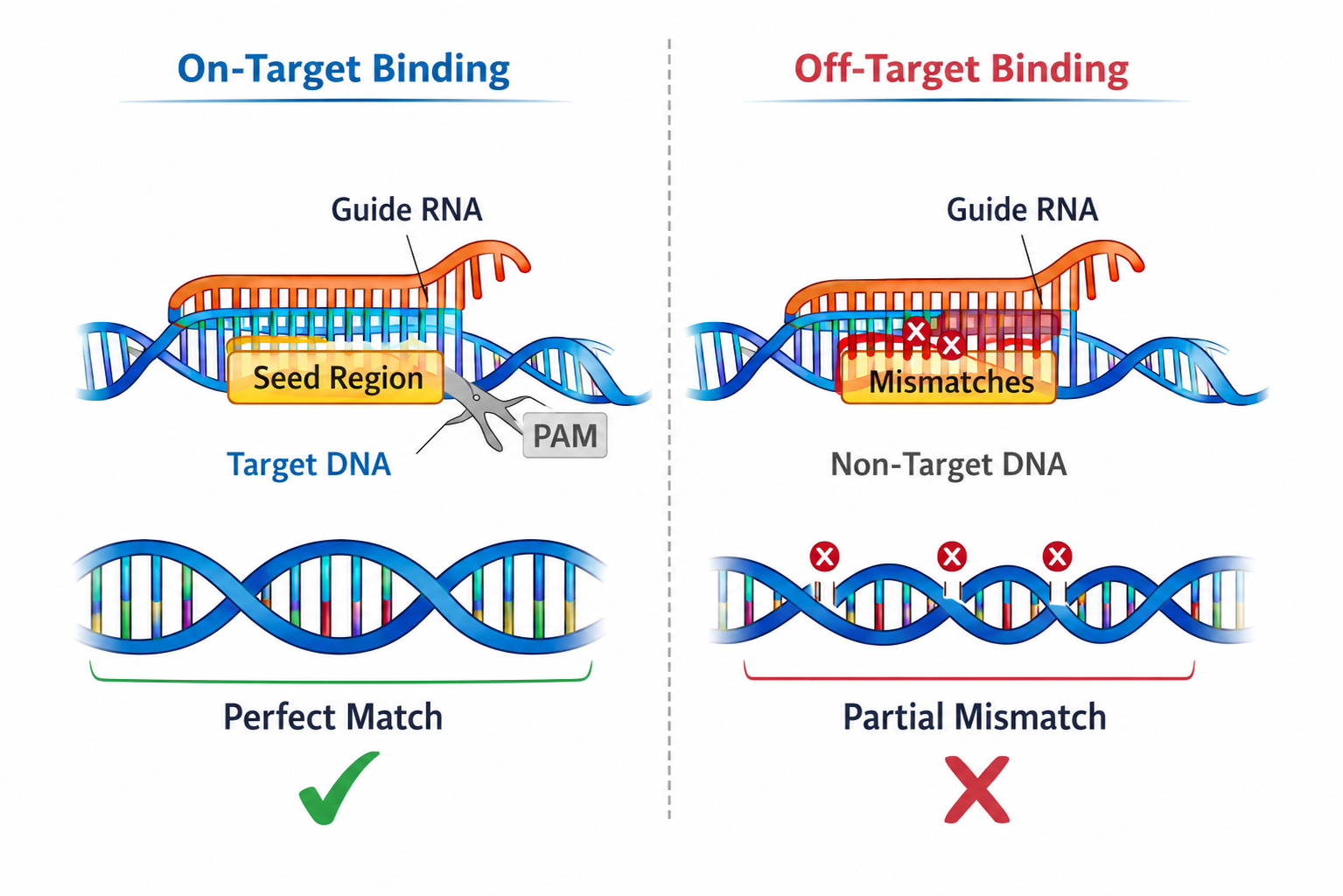
Figure 1. Schematic comparison of on-target and off-target CRISPR binding. On-target binding (left) occurs when the guide RNA is fully or highly complementary to the target DNA sequence adjacent to the PAM, enabling efficient and specific DNA cleavage. Off-target binding (right) occurs when partial mismatches exist between the guide RNA and non-target DNA sequences with sufficient similarity, which may still permit binding and unintended cleavage.
How are Off-target Effects Detected and Measured?
Accurate characterization of off-target activity requires a combination of experimental and computational approaches. High-throughput sequencing-based techniques remain the gold standard for detection, enabling genome-wide identification of unintended cleavage events. Methods such as GUIDE-seq, CIRCLE-seq, and Digenome-seq provide sensitive and unbiased detection of double-strand breaks, while newer approaches incorporate chromatin context and in vivo repair signals to better reflect physiological conditions 3, 4.
Complementing these experimental techniques, computational prediction tools (Figure 2) identify potential off-target sites by scanning the genome for sequences similar to the intended target. Recent advances increasingly rely on machine learning models trained on large experimental datasets to improve predictive accuracy. These AI-driven tools incorporate diverse features, including sequence mismatch patterns, positional effects, thermodynamic stability, and chromatin accessibility or other epigenetic factors, thereby improving predictive performance. However, despite these advances, such models remain constrained by incomplete representation of complex cellular environments and therefore still require experimental validation to ensure reliability 5. 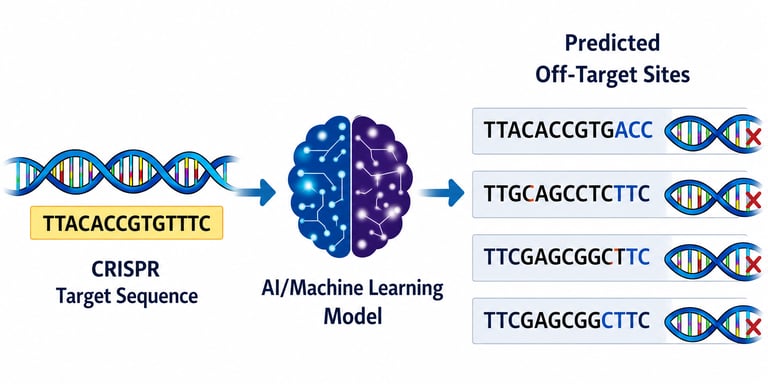 Figure 2. Schematic overview of AI-based prediction of CRISPR-Cas off-target sites. The CRISPR target sequence is input into a machine learning model, which analyses sequence features and mismatch patterns to identify potential off-target sites across the genome. Representative tools such as DeepCRISPR 6 and CRISPR-Net 7 use experimentally derived datasets (e.g., GUIDE-seq) to predict genomic loci with partial sequence similarity that may be susceptible to unintended editing.
CRISPR-Cas vs AI-Assisted Gene Editing Systems
Traditional CRISPR–Cas systems have been optimized through improved guide RNA design and the development of high-fidelity Cas variants that reduce non-specific DNA interactions. However, intrinsic limitations in RNA–DNA base pairing mean that some off-target activity can still occur particularly in genomic regions with high sequence similarity.
AI-assisted gene editing systems represent a significant shift in strategy. Rather than relying solely on biochemical optimization, these systems integrate computational modelling of nuclease structure and protein–DNA interactions, alongside large-scale data analysis to design guides and engineer nucleases with enhanced specificity. Recent studies demonstrate that machine learning approaches can significantly improve off-target prediction accuracy and guide RNA selection, reducing unintended editing events in preclinical settings 8. However, these systems remain under active validation, and their performance can vary depending on genomic context, delivery method, and cell type.

Clinical Implications of Off-target Effects in Cell-Based Therapies
In cell-based therapies, such as gene-edited induced pluripotent stem cell (iPSC) products, off-target effects are managed through controlled, ex vivo workflows. Because editing is performed in a clonal context, individual cell lines can be screened and selected based on genomic quality.
Whole-genome sequencing (WGS) enables detection of both intended edits (on-target edits) and potential off-target variants, supporting the selection of clones with high sequence fidelity. For example, REPROCELL applies WGS alongside chromosomal analysis to monitor genomic integrity throughout manufacturing. This analysis captures both intended edits as well as indels (unintended variants) at predicted off-target genomic loci, enabling the selection of genetically engineered clones based on genome stability and safety profile.
Regulatory expectations reflect this approach. The U.S. Food and Drug Administration recommends risk-based safety testing for allogeneic cell-based products, including assessment of genomic stability and tumorigenic risk. This highlights the importance of comprehensive genomic screening before clinical use 9.
AI-driven Gene Editing and Translational Context
The integration of artificial intelligence into gene editing workflows reflects a broader shift toward precision-driven biotechnology. AI models are now used not only to predict off-target sites but also to design optimized editing systems with improved specificity. In this context, the StemEdit platform, developed by REPROCELL—combines iPSC expertise with AI-designed OpenCRISPR-1 technology. This includes the StemEdit OC-1 Protein, an AI-designed recombinant nuclease that enables researchers to perform high-efficiency genome editing directly in their own laboratories. This illustrates how computational design and experimental validation are becoming tightly integrated in translational workflows, where minimizing off-target effects is treated as a core design requirement rather than a secondary optimization step.
However, reducing predicted off-target edits alone is not sufficient for clinical translation. Genomic monitoring must be applied across the entire workflow. Upstream monitoring (e.g., donor fibroblasts and iPSC seed clones) enables early detection of pre-existing or editing-induced variants, while downstream testing at the master and working cell bank stages confirms genomic stability prior to clinical use. Whole-genome sequencing–based assays, including OncoPanel screening, provide a systematic approach to identifying variants associated with cancer risk throughout this process.
This combined strategy: predict → edit → validate → monitor across the manufacturing lifecycle—aligns with risk-based regulatory frameworks and represents an emerging best practice for ensuring both precision and safety in advanced cell therapy development.
Conclusion
Off-target effects remain an important consideration in gene editing, but in cell-based therapies, particularly gene-edited iPSC products, they can be effectively managed through clonal selection and genomic screening. Advances in AI-driven design and sequencing technologies have improved both prediction and detection of unintended edits.
Rather than a fundamental barrier, off-target activity is increasingly addressed through integrated workflows combining design, validation, and longitudinal monitoring, supported by risk-based regulatory frameworks from the U.S. Food and Drug Administration.
References
-
Asmamaw Mengstie, M., Teshome Azezew, M., Asmamaw Dejenie, T., Teshome, A.A., Tadele Admasu, F., Behaile Teklemariam, A., Tilahun Mulu, A., Mekonnen Agidew, M., Adugna, D.G., Geremew, H., Abebe, E.C. Recent advancements in reducing the off-target effect of CRISPR-Cas9 genome editing. Biologics, 18 (2024).
-
Chen, Y. H. Off-target effects in genome editing: prediction and mitigation strategies. Computational Molecular Biology, 14 (2024).
-
Lopes, R. and Prasad, M. K. Beyond the promise: evaluating and mitigating off-target effects in CRISPR gene editing for safer therapeutics. Frontiers in Bioengineering and Biotechnology, 11 (2024).
-
Lotfi, M., Farshchian Yazdi, Z., Hashemi, M. R., Abbaszadegan, M. R. and Sharif, S. Guarding the genome: strategies for off-target detection and minimization in CRISPR/Cas9 system. Expert Review of Molecular Diagnostics, 25 (2025).
-
Huang, W.Z. Computational prediction of off-target effects in CRISPR systems. Computational Molecular Biology, 15 (2025).
-
Chuai, G., Ma, H., Yan, J., Chen, M., Hong, N., Xue, D., Zhou, Zhu, C., Chen, K., Duan, B., Gu, F., Qu, S., Huang, D., Wei, J. and Liu, Q. DeepCRISPR: optimized CRISPR guide RNA design by deep learning. Genome Biology, 19 (2018).
-
Lin, J., Zhang, Z., Zhang, S., Chen, J. and Wong, K. (2020). CRISPR-Net: A Recurrent Convolutional Network Quantifies CRISPR Off-Target Activities with Mismatches and Indels. Advanced Science, 7 (2020).
-
Bingham, G., Arussy, N. and Zonouz, S. Guide-Guard: Machine learning-based off-target prediction. Lecture Notes in Computer Science, 13756. (2026).
- U.S. Food and Drug Administration. Safety Testing of Human Allogeneic Cells Expanded for Use in Cell-Based Medical Products. Draft Guidance for Industry (2024).
About the author
Dayana Ivanova, Marketing and Business Administration, Stem Cells
Dayana combines her strong Medical Sciences background with her growing enthusiasm for digital marketing. She’s passionate about blending her scientific expertise with creative content development, making complex topics accessible and engaging. Outside of work, you’ll find Dayana staying active, traveling, and immersing herself in diverse cultures and cuisines. Connect with Dayana on LinkedIn: linkedin.com/in/dayanaivanova
Subjects we write about
- 3D Cell Culture
- Cell Culture
- Central Lab Services
- Clinical Capabilities
- Disease Modeling
- Drug Discovery
- Gene Editing
- Genomic Services
- GMP
- Human Tissue Samples
- Human Tissue Testing
- IBD
- Life Sciences
- Master Cell Banks
- Neurons
- Oligonucleotide Synthesis
- Pharmacology-AI
- Precision Medicine
- Product Catalog
- Regenerative Medicine
- Respiratory Disease
- Safety Pharmacology
- Skin Disease
- Stem Cells