.png?width=1280&height=720&name=hubspot_featured_image_1200x628%20(1).png)
Induced pluripotent stem cells (iPSCs) are rapidly advancing regenerative medicine and cell therapy because they can differentiate into multiple human cell types. However, immune rejection remains a major barrier to developing scalable allogeneic cell therapies.
In a recent webinar, Dr. Luke Ren from REPROCELL presented how the company is using StemEdit, its advanced gene editing platform, to engineer hypoimmune iPSCs for off-the-shelf allogeneic cell therapy applications. The approach aims to create universal donor stem cells with reduced immune recognition, improving compatibility across patient populations.
Hypoimmune iPSCs and Immune Evasion
Traditional autologous cell therapies use a patient’s own cells, minimizing immune rejection risk but increasing manufacturing complexity, cost, and production timelines. In contrast, allogeneic therapies rely on donor-derived cells that can be manufactured at scale, but they face immune compatibility challenges (Figure 1).
To address this issue, researchers are developing hypoimmune iPSCs by editing genes involved in immune recognition pathways. During the webinar, Dr. Ren discussed targeting genes such as B2M and CIITA, which are associated with antigen presentation and immune detection.
By disrupting these pathways, engineered iPSCs become less visible to the immune system, supporting the development of universal donor cell therapies for regenerative medicine and immunotherapy applications. However, CIITA knockout can increase susceptibility to natural killer (NK) cell-mediated clearance. To overcome this challenge, researchers can use Landing Pad technology to introduce immune-modulating proteins such as CD47, a “do-not-eat-me” signal that helps protect engineered cells from immune attack while maintaining hypoimmune properties.
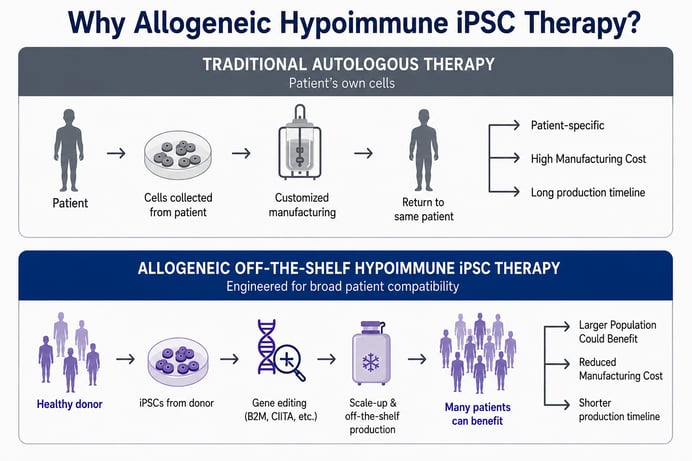 Figure 1. Autologous vs. allogeneic hypoimmune iPSC therapy. Autologous therapies require patient-specific manufacturing, resulting in higher costs and longer production timelines. Hypoimmune allogeneic iPSC therapies use gene-edited donor-derived iPSCs to reduce immune recognition, enabling scalable off-the-shelf production, broader patient access, lower costs, and faster treatment availability.
StemEdit and AI-Driven CRISPR Genome Editing
Precise genome engineering is essential for creating clinically relevant hypoimmune stem cells. REPROCELL’s StemEdit platform combines advanced CRISPR gene-editing technologies with optimized editing workflows for stem cell engineering applications. The StemEdit platform also includes StemEdit OC-1 Protein, an AI-designed recombinant nuclease that enables researchers to perform high-efficiency genome editing directly in their own laboratories.
According to the webinar, StemEdit demonstrated:
• High gene-editing efficiency in iPSCs
• Reduced off-target editing activity
• Consistent performance across multiple stem cell lines
• Maintenance of pluripotency and genomic stability after editing
These characteristics are critical for translational research and future therapeutic development. StemEdit is also offered as a license-free gene editing service, helping researchers and cell therapy developers reduce intellectual property barriers and streamline therapeutic development.
Applications in Regenerative Medicine and Cell Therapy
During the webinar, Dr. Ren demonstrated efficient genome editing in iPSCs with edited cells maintaining pluripotency and genomic stability after engineering.
Using StemEdit, researchers achieved high-efficiency knockout of immune-related genes associated with immune recognition, supporting the development of hypoimmune stem cells for allogeneic cell therapy applications. REPROCELL can further leverage these edited iPSCs by differentiating them into induced mesenchymal stem cells (iMSCs), enabling the generation of hypoimmune iMSCs for regenerative medicine and cell therapy applications. This approach combines precise genome engineering with scalable iMSC production to support the development of next-generation off-the-shelf cell therapies.
The StemEdit platform also supports advanced genome engineering approaches beyond gene disruption. Through Landing Pad technology, researchers can precisely insert multiple therapeutic payloads into safe genomic loci, enabling controlled integration of CAR constructs, engineered receptors, and immune-modulating proteins. This streamlined workflow can reduce development timelines and manufacturing costs for complex cell therapy programs.
In addition to targeted gene knock-ins, StemEdit supports multiplex editing and gene regulation workflows, providing flexibility for complex cell engineering strategies in regenerative medicine and immunotherapy development.
The Future of AI-Driven Genome Engineering
Artificial intelligence is accelerating advances in CRISPR gene editing and stem cell engineering. With platforms like StemEdit, researchers can develop hypoimmune iPSCs with improved precision, scalability, and reduced immune rejection risk for off-the-shelf cell therapy applications. REPROCELL’s work highlights how AI-driven genome engineering is rapidly moving toward practical use in regenerative medicine and cell therapy development.
References
- Webinar (video): Ren, L. Engineering Hypoimmune iPSCs Using StemEdit Gene Editing Technology. REPROCELL Webinar, 2026.

About the author
Dayana Ivanova, Marketing and Business Administration, Stem Cells
Dayana combines her strong Medical Sciences background with her growing enthusiasm for digital marketing. She’s passionate about blending her scientific expertise with creative content development, making complex topics accessible and engaging. Outside of work, you’ll find Dayana staying active, traveling, and immersing herself in diverse cultures and cuisines. Connect with Dayana on LinkedIn: linkedin.com/in/dayanaivanova
Subjects we write about
- 3D Cell Culture
- Cell Culture
- Central Lab Services
- Clinical Capabilities
- Disease Modeling
- Drug Discovery
- Gene Editing
- Genomic Services
- GMP
- Human Tissue Samples
- Human Tissue Testing
- IBD
- Life Sciences
- Master Cell Banks
- Neurons
- Oligonucleotide Synthesis
- Pharmacology-AI
- Precision Medicine
- Product Catalog
- Regenerative Medicine
- Respiratory Disease
- Safety Pharmacology
- Skin Disease
- Stem Cells