
REPROCELL has recently launched StemEdit OC-1 Protein, the world’s first gene-editing enzyme engineered using generative AI. Licensed from Profluent Bio based on OpenCRISPR-1™, StemEdit OC-1, serves as the core nuclease of REPROCELL’s StemEdit genome engineering platform. REPROCELL has since expanded the platform beyond the nuclease to include integrated gene editing products, engineered cell lines, and custom genome engineering services, creating a comprehensive, license-free genome engineering platform for stem cell research disease modeling, drug discovery and translational development.
Ready for Discovery: R&D and Beyond
The StemEdit OC-1 Protein is currently available for Research and Development (R&D) purposes, serving as the most reliable base for your gene-editing projects. To ensure researchers receive a reliable and high-performing product, every batch of StemEdit OC-1 is strictly quality controlled for editing activity (Figure 1) and sterility.
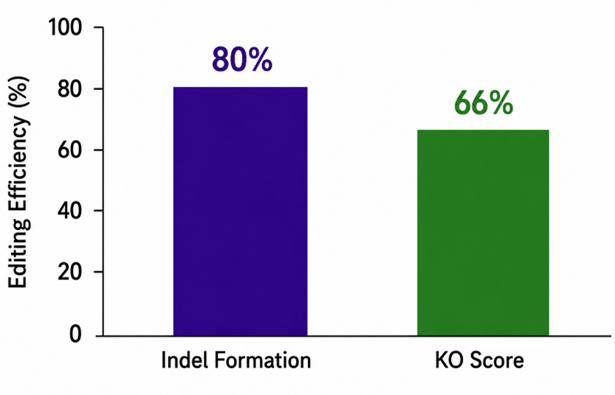 Figure 1. StemEdit OC-1 Protein QC assay performed in a StemRNA induced pluripotent stem cell (iPSC) line using a test gRNA. Editing efficiency was analyzed using the ICE App.
Furthermore, we recognize the importance of clinical translatability; for partners moving toward human clinical trials, a GMP-grade version of StemEdit OC-1 Protein is coming soon, providing a seamless regulatory bridge from early-stage research to therapeutic manufacturing.
Advantages of StemEdit OC-1 Protein: Why Offers Key Advantages
StemEdit OC-1 is delivered as a purified nuclease protein. When combined with a guide RNA, OC-1 forms a ribonucleoprotein (RNP) complex — the functional genome-editing unit composed of the nuclease protein and the RNA molecule that directs it to the specific genomic target. This RNP format enables direct delivery of the active editing machinery into cells, maintaining efficient genome editing while offering several important advantages compared with traditional plasmid-based delivery.
-
Superior Safety and Precision: Plasmids can persist in cells for weeks, expressing the enzyme for far longer than necessary and increasing the risk of off-target edits. In contrast, protein-based OC-1 acts rapidly and is degraded within approximately 24 hours, contributing to a 95% reduction in off-target activity compared to standard Cas9 1.
-
Elimination of Integration Risk: Using the StemEdit OC-1 Protein delivers the genome editor directly as a RNP complex rather than through plasmid DNA, avoiding the introduction of exogenous DNA into target cells and providing a transient genome-editing approach 2.
-
Higher Cell Viability: Plasmid DNA transfection can induce substantial cellular stress and reduce viability, particularly in sensitive cell types such as primary cells and iPSCs 3. Delivering the editor as a preformed RNP complex provides only transient intracellular exposure and, depending on the delivery strategy, may reduce cellular perturbation and better preserve cell viability and phenotype 4.
- Accelerated Results: Direct protein delivery bypasses the need for intracellular transcription and translation, enabling more rapid editing activity and potentially shortening experimental timelines 2.
Clinical Freedom with License-Free Access
The complex intellectual property landscape and licensing considerations associated with traditional CRISPR-Cas9 technologies have created challenges for many researchers and developers advancing gene-editing applications. StemEdit OC-1 provides an alternative approach by offering access to an AI-designed CRISPR nuclease platform without the licensing restrictions associated with conventional CRISPR systems*. With a sequence distinct from naturally occurring CRISPR nucleases, OC-1 offers a differentiated technology platform designed to support flexible adoption across research and commercial applications. REPROCELL provides StemEdit OC-1 through a license-free model for research and clinical use, reducing financial and administrative barriers and enabling researchers to accelerate innovation in genome engineering.
*Users remain responsible for ensuring compliance with any applicable third-party intellectual property covering guide RNAs, delivery methods, and downstream applications.
Conclusion
StemEdit OC-1 represents a new generation of genome-editing technology, combining AI-designed nuclease innovation with the precision and flexibility needed for advanced cell engineering applications, including hypoimmune iPSC engineering and next-generation cell therapy development.
Bring the power of AI-designed gene editing to your lab. StemEdit OC-1 is available for purchase today. Contact REPROCELL to discover how this breakthrough technology can help accelerate your research and support the path from discovery toward clinical translation.
References
-
Ruffolo, J.A., Nayfach, S., Gallagher, J. et al. Design of highly functional genome editors by modelling CRISPR–Cas sequences. Nature 645, 518–525 (2025).
-
Kevadiya, B.D., Islam, F., Deol, P., Zaman, L.A., Mosselhy, D.A., Md Ashaduzzaman, Bajwa, N., Routhu, N. K., Singh, P.A.,Dawre, S., Vora, L. K., Nahid, S., Mathur, M., Nayan, M. U., Baldi, A., Kothari, R., Patel, T. A., Madan, J., Gounani, Z., Bariwal, J., Hettie, K. S. and Gendelman, H. E. Delivery of gene editing therapeutics. Nanomedicine: Nanotechnology, Biology and Medicine, 54 (2023).
-
Lesueur LL, Mir LM, André FM. Overcoming the Specific Toxicity of Large Plasmids Electrotransfer in Primary Cells In Vitro. Mol Ther Nucleic Acids, 5(3):e291. (2016).
- Sahu, S.U., Castro, M., Muldoon, J.J. et al. Peptide-enabled ribonucleoprotein delivery for CRISPR engineering (PERC) in primary human immune cells and hematopoietic stem cells. Nat Protoc, 20, 2735–2770 (2025).

About the author
Dayana Ivanova, Marketing and Business Administration, Stem Cells
Dayana combines her strong Medical Sciences background with her growing enthusiasm for digital marketing. She’s passionate about blending her scientific expertise with creative content development, making complex topics accessible and engaging. Outside of work, you’ll find Dayana staying active, traveling, and immersing herself in diverse cultures and cuisines. Connect with Dayana on LinkedIn: linkedin.com/in/dayanaivanova
Subjects we write about
- 3D Cell Culture
- Cell Culture
- Central Lab Services
- Clinical Capabilities
- Disease Modeling
- Drug Discovery
- Gene Editing
- Genomic Services
- GMP
- Human Tissue Samples
- Human Tissue Testing
- IBD
- Life Sciences
- Master Cell Banks
- Neurons
- Oligonucleotide Synthesis
- Pharmacology-AI
- Precision Medicine
- Product Catalog
- Regenerative Medicine
- Respiratory Disease
- Safety Pharmacology
- Skin Disease
- Stem Cells