REPROSKIN™ Full Thickness Human Skin Equivalent
RSK001-FT-6 / RSK001-FT-12 / RSK-MEDIA-001
Brand: Alvetex®
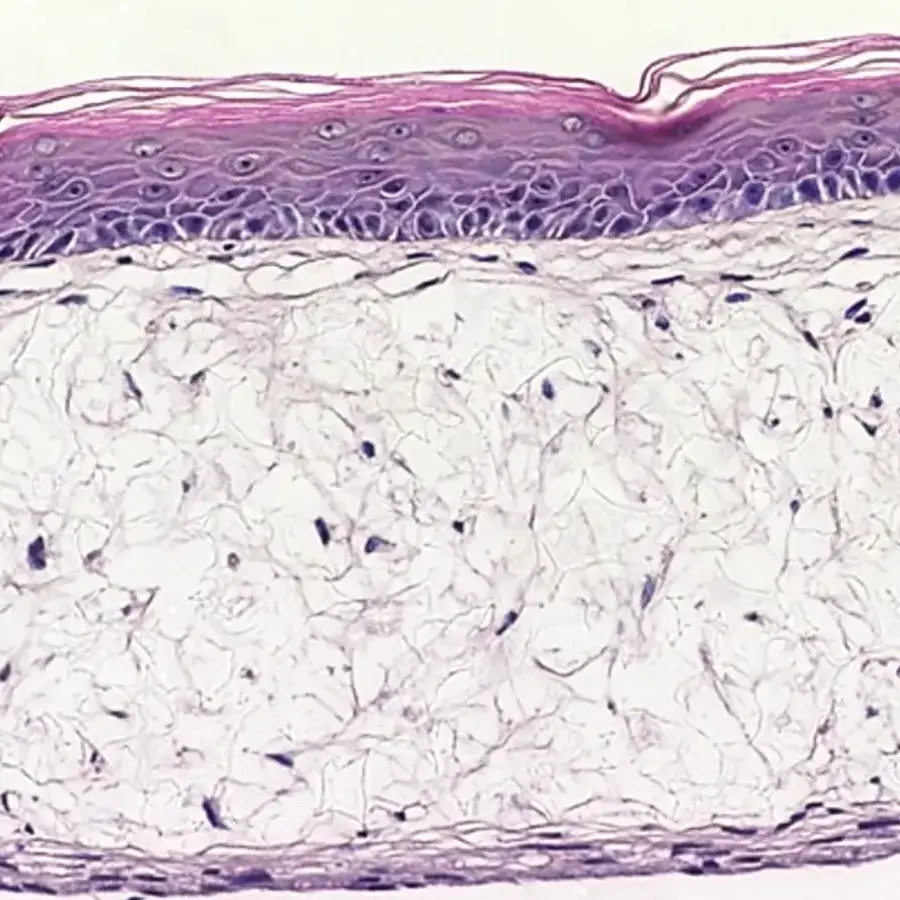
REPROSKIN™ Full Thickness Human Skin Equivalent is designed to provide a physiologically relevant in vitro model for preclinical dermatology research, toxicity testing and mechanistic studies. Each tissue incorporates both epidermal and dermal components, produced using human primary keratinocytes and dermal fibroblasts, and is cultured at an air–liquid interface to support stratified epidermal morphology and barrier function.
Supplied as removable inserts in a deep 6-well plate with accessories, REPROSKIN™ offers researchers a convenient, ready-to-use skin model with defined handling, quality control and safety criteria for reproducible experimental use.
| Product name | Catalog number | Pack size | Price | Price | Price (USD) | Price (GBP) | Price (EUR) |
|---|---|---|---|---|---|---|---|
| REPROSKIN™ Full Thickness Human Skin Equivalent, 1 plate | RSK001-FT-6 | 1 plate | Ask us | $ | £ | € | |
| REPROSKIN™ Full Thickness Human Skin Equivalent, 2 plates | RSK001-FT-12 | 2 plates | Ask us | $ | £ | € |
Note: REPROSKIN™ can be ordered in larger quantities, in multiples of 6 models. Contact us for more information.
Make an inquiry
Maintenance media and supplements
| Product name | Catalog number | Pack size | Price |
|---|---|---|---|
| REPROSKIN™ Maintenance Media Kit | RSK-MEDIA-001 | 1 kit | Ask us |
| EpiLife™ Medium, with 60 μM calcium | MEPI500CA | 500 mL | (See page) |
| Recombinant human KGF (FGF-7) protein | QK046-0025 | 25 µg | (See page) |
Overview
REPROSKIN is a bioengineered full-thickness human skin model that combines primary human fibroblasts, primary human keratinocytes and proprietary Alvetex® technology to recreate the structure and function of native human skin. Designed for researchers who need more biologically relevant data than conventional cell culture can provide, REPROSKIN delivers a living, three-dimensional tissue model suitable for efficacy, safety, barrier function and skin biology studies.
Unlike simplified skin models, REPROSKIN allows cells to establish their own tissue architecture, producing a stratified epidermis supported by a biologically relevant dermal compartment. The result is a highly characterised skin equivalent that exhibits key hallmarks of fresh human skin while providing the reproducibility required for routine laboratory research.
Built on the Alvetex® Advanced platform, REPROSKIN is designed to make live human skin research more practical. Researchers can access the epidermal surface for topical dosing, UV exposure, tape stripping and barrier function measurements, while the flexible insert format supports downstream analysis and longitudinal studies.
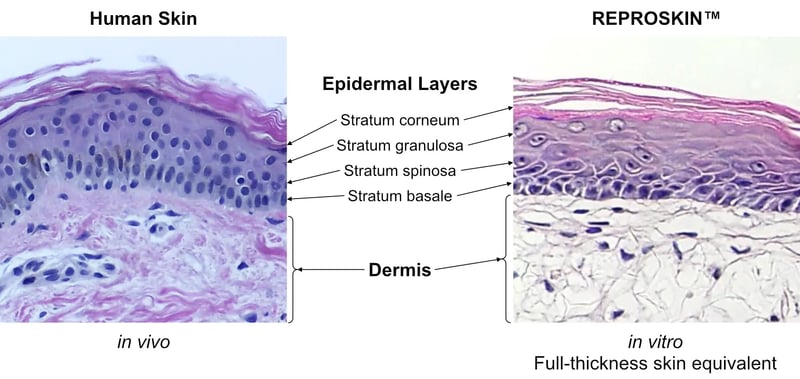
REPROSKIN is suitable for a wide range of applications, including dermatology research, toxicology, cosmetic testing, wound healing studies, pigmentation research and mechanistic investigations of skin biology. Models are available for use within your own laboratory or through REPROCELL's contract research services, providing flexibility to match your research needs.
Why Choose REPROSKIN
-
Human-relevant biology
Primary human fibroblasts and keratinocytes form a full-thickness tissue architecture. -
Customer control
Teams can run studies in their own laboratories rather than relying only on outsourced service work. -
Practical testing window
Fresh shipment and acclimatisation support experiments for up to seven days. -
Application breadth
Accessible epidermal surface enables topical dosing, probes, barrier measurements and wound-healing workflows.
Key Benefits of REPROSKIN
- Full-thickness human skin equivalent with epidermal and dermal layers.
- Constructed from primary human skin cells.
- Developed using our proprietary Alvetex® Advanced 3D tissue bioengineering technology.
- Accessible epidermal surface for topical applications and exposure studies.
- Supports barrier function, safety, efficacy and mechanistic research.
Note: REPROCELL's Preclinical Drug Discovery CRO also has a REPROSKIN bioengineered 3D tissue model assay service.
Technical Specifications
1. Product Overview
- Product Name: REPROSKIN™ Full Thickness Human Skin Equivalent
- Product SKU: RSK001-FT-6 (6 models) / RSK001-FT-12 (12 models)
- Product Type: Bioengineered full-thickness human skin tissue model
- Application Area: Preclinical research, dermatology, toxicity testing, mechanistic studies
- Available Formats: Typically provided as individual removable inserts in a deep 6-well plate
- Kit Contents: REPROSKIN™ tissues, Alvetex Advanced™ inserts and accessories.
2. Tissue Characteristics
- Structure: Full-thickness skin equivalent (epidermis + dermis)
- Dimensions: Diameter of skin surface is 12 mm; surface area of 1.13 cm2; skin thickness (depth) of approximately 200 µm.
- Histology: Stratified epidermis with barrier function
- Culture Method: Air–liquid interface
3. Cellular Composition
- Primary cell types: Human primary neonatal foreskin keratinocytes, human primary neonatal dermal fibroblasts.
4. Culture Conditions
- Base medium: EpiLife™ culture medium, with 60 μM calcium
- Supplements: Keratinocyte Growth Factor (KGF) (QK046-0025)
- Antibiotics: Penicillin/Streptomycin 1%
5. Handling and Use
- Recommended use window: Seven days, following a one-day rest period after receipt. Skin can be kept in culture for at least 10 days with good retention of epidermal morphology.
- Feeding: REPROCELL recommends culture media changes be conducted twice weekly
6. Shipment and Receipt
- Shipping conditions: Shipped at ambient temperatures in agarose gels.
- Shelf life: Upon receipt (assuming arrival within 72 hours from dispatch), tissues should be allowed to recover in culture for 24 hours prior to use.
7. Quality Control
- Lot tracking: Unique lot numbers are assigned to each manufacturing run. All skin tissues within a lot are generated from the same primary cells and media.
- Testing: Morphology and viability assays
- Acceptance criteria: Appearance of a waxy, intact surface area and H&E evaluation of one REPROSKIN tissue from each lot.
8. Safety
- Screening of primary cells (by original commercial provider): HIV, Hep B, Hep C, mycoplasma. Agarose gel used for shipping is prepared sterilized.
- Handling: Follow BSL-2 guidelines
9. Ordering Information
Orders can be placed via the REPROCELL.com website or by emailing orders@reprocell-europe.com.
Please contact REPROCELL via info@reprocell-europe.com to discuss custom products or contract research services.
Documentation
Application Note
References
-
Reconstruction of native cellular microanatomy in a novel bioengineered full thickness human nasal mucosal construct
Steven Bradbury, Bethany Dickson, Nicola Curtis, David Bunton, Kirsty Goncalves, Stefan Przyborski
Journal of Anatomy, 16 March 2026. DOI: 10.1111/joa.70130 -
Bioengineering a Human Dermal Equivalent Using Induced Pluripotent Stem Cell-Derived Fibroblasts to Support the Formation of a Full-Thickness Skin Construct
Lucy Smith, David Bunton, Michael Finch, and Stefan Przyborski
Cells, 8 July 2025. DOI: 10.3390/cells14141044 -
Engineering a Pigmented Skin Equivalent That Is Responsive to External Stimuli
Paola De Los Santos Gomez, Kirsty Goncalves, Victoria Maltman, Lucy Smith & Stefan Przyborski
Skin Tissue Engineering, 11 April 2025. DOI: 10.1007/978-1-0716-4510-9_9 -
Engineering a Multilayered Skin Equivalent: The Importance of Endogenous Extracellular Matrix and Model Flexibility for Nuanced and Accurate Skin Studies
Lucy Smith, Victoria Maltman, Paola De Los Santos Gomez, Kirsty Goncalves & Stefan Przyborski
Skin Tissue Engineering, 11 April 2025. DOI: 10.1007/978-1-0716-4510-9_12 -
Assessing the impact of airborne particulate pollution on human skin utilizing a novel human skin equivalent containing MUTZ-3-derived Langerhans cells
Matthew Freer, Jim Cooper, Kirsty Goncalves, and Stefan Przyborski
Bioengineering and Translational Medicine, 13 Dec 2024. DOI: 10.1002/btm2.10738 -
Bioengineering the Human Intestinal Mucosa and the Importance of Stromal Support for Pharmacological Evaluation In Vitro
Matthew Freer, Jim Cooper, Kirsty Goncalves, and Stefan Przyborski
Cells, 8 Nov 2024. DOI: 10.3390/cells13221859 -
Investigation into the significant role of dermal-epidermal interactions in skin ageing utilising a bioengineered skin construct
Lydia Costello, Kirsty Goncalves, Paola De Los Santos Gomez, Ben Hulette, Teresa Dicolandrea, Michael J. Flagler, Robert Isfort, John Oblong, Charlie Bascom, Stefan Przyborski
Journal of Cellular Physiology, 8 Oct 2024. DOI: 10.1002/jcp.31463 -
Cell Senescence-Independent Changes of Human Skin Fibroblasts with Age
Nicola Fullard, James Wordsworth, Ciaran Welsh, Victoria Maltman, Charlie Bascom, Ryan Tasseff, Robert Isfort, Lydia Costello, Rebekah-Louise Scanlan, Stefan Przyborski, and Daryl Shanley
Cells, 9 April 2024. DOI: 10.3390/cells1308065. -
An in vitro model to study immune activation, epithelial disruption and stromal remodelling in inflammatory bowel disease and fistulising Crohn’s disease
Claire L. Mobbs, Nicole J. Darling and Stefan Przyborski
Frontiers in Immunology, 12 February 2024. DOI: 10.3389/fimmu.2024.1357690 -
Development of a mammalian neurosensory full-thickness skin equivalent and its application to screen sensitizing stimuli
Freer M, Darling N, Goncalves K, Mills KJ, Przyborski S.
Bioengineering and Translational Medicine, January 2023. DOI: 10.1002/btm2.10484
-
Investigation into the effect of skin tone modulators and exogenous stress on skin pigmentation utilizing a novel bioengineered skin equivalent
Kirsty Goncalves, Paola De Los Santos Gomez, Lydia Costello, Lucy Smith, Hugh Mead, Amy Simpson, Stefan Przyborski
Bioengineering and Translational Medicine, 26 September 2022. DOI: 10.1002/btm2.10415 -
Bioengineering the microanatomy of human skin
Mathilde Roger, Nicola Fullard, Lydia Costello, Steven Bradbury, Ewa Markiewicz, Steven O'Reilly, Nicole Darling, Pamela Ritchie, Arto Määttä, Iakowos Karakesisoglou, Glyn Nelson, Thomas von Zglinicki, Teresa Dicolandrea, Robert Isfort, Charles Bascom, Stefan Przyborski
Journal of Anatomy. 10 Feb 2019. DOI: 10.1111/joa.12942