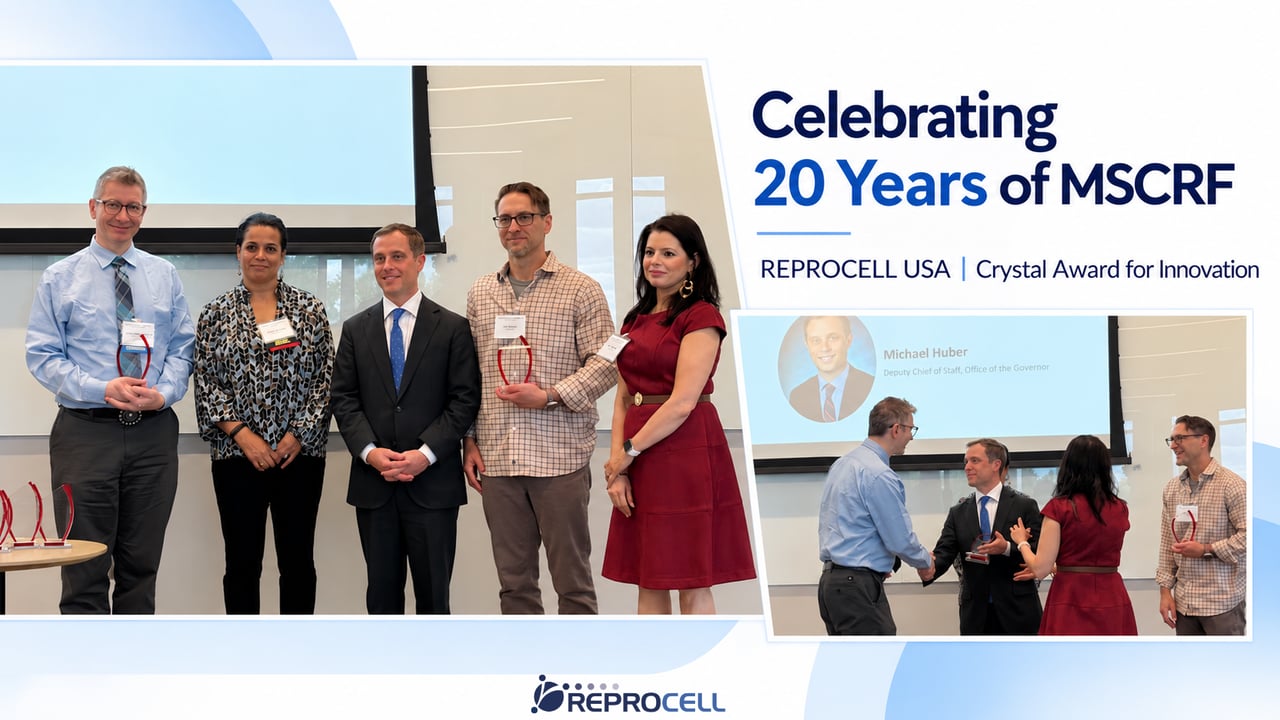
REPROCELL USA has received a Crystal Award for Innovation at the Maryland Stem Cell Research Fund’s (MSCRF) 20th Anniversary Felicitation Ceremony, recognizing the company’s contribution to advancing stem cell research and regenerative medicine. The recognition follows several MSCRF-supported projects spanning GMP manufacturing, cell banking and the development of engineered induced pluripotent stem cells (iPSC) platforms.
Together, these projects reflect a broader focus: building the technologies and manufacturing capabilities needed to support the progression of stem cell research toward translational and cell therapy applications.
Key Takeaways
-
MSCRF funding has supported REPROCELL’s expansion into disease modelling and immunology, from iPSC and neural stem cell banks for neurodegenerative disease research to iPSC-derived natural killer (NK) cell development.
-
MSCRF funding has supported REPROCELL’s expansion of GMP iPSC manufacturing, including Master Cell Bank production and cell therapy manufacturing infrastructure in Maryland.
-
REPROCELL is advancing gene editing StemEdit iPSC technology through hyopimmune iPSC development, building on research-grade B2M/CIITA knockout models toward clinically aligned iPSC starting materials.
- REPROCELL’s contribution to stem cell innovation was recognized at MSCRF’s 20th Anniversary, alongside its ongoing work in regenerative medicine and cell therapy development.
MSCRF Support for Stem Cell and Regenerative Medicine
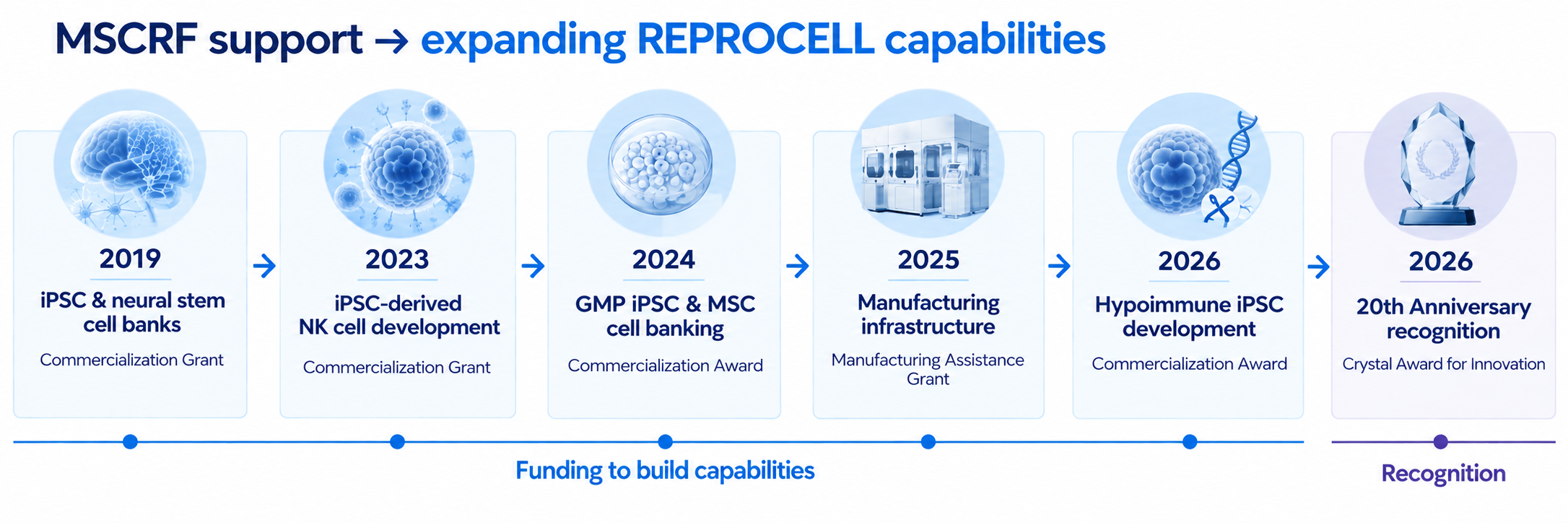
Fig 1. MSCRF support for REPROCELL USA from 2024–2026, spanning GMP cell banking, manufacturing infrastructure and hypoimmune iPSC development, followed by recognition at MSCRF’s 20th Anniversary Celebration.
Established under the Maryland Stem Cell Research Act of 2006, the Maryland Stem Cell Research Fund provides competitive, non-dilutive funding for stem cell and regenerative medicine research and innovation in Maryland. Its programs support projects across the development continuum, including research, clinical translation, commercialization and manufacturing.
REPROCELL USA, based in Beltsville, Maryland, has received MSCRF support for several projects addressing different stages of this continuum (Figure 1).
REPROCELL has received grant support for initiatives spanning disease modeling, cell banking, and advanced cell manufacturing. In 2019, REPROCELL USA received a Maryland Stem Cell Research Fund grant to develop iPSC and neural stem cell banks derived from healthy controls and patients with neurodegenerative diseases, with the goal of improving researchers’ access to disease models for research and drug discovery.
In 2023, REPROCELL received a grant to develop ready-to-use NK cells derived from human iPSCs, supporting the company’s expansion into immunology and hematology.
In 2024, REPROCELL received a $394,005 Commercialization Award for a project focused on generating human iPSC and MSC Master Cell Banks (MCBs) and derivative products using an enclosed GMP system. The project expanded REPROCELL’s capabilities for manufacturing clinically relevant stem cell banks within the Cytocentric® Xvivo closed system.
This capability contributed to REPROCELL’s GMP Master Cell Bank manufacturing services for clinical iPSC programs.
Expanding GMP Manufacturing for iPSC Therapy Development
MSCRF support continued in 2025 through its Manufacturing Assistance Grant Program. REPROCELL was awarded up to $357,881, structured as a 1:1 matching grant, for the project Development of a Centralized (GMP) Contract Development and Manufacturing Organization (CDMO) and iGRP Manufacturing.
The project supports expanded cleanroom infrastructure in Maryland for larger-scale GMP cell therapy manufacturing. It is intended to broaden capabilities including working cell bank production, GMP differentiation, gene editing and manufacturing of iPSC-derived cell types.
For cell therapy developers, this type of infrastructure addresses an important translational challenge: connecting well characterized stem cell starting material with controlled downstream manufacturing processes.
The investment complements REPROCELL’s existing clinical stem cell services, which integrate clinical iPSC generation, gene editing and GMP cell banking.
From Research-Grade to Clinical-Grade Hypoimmune iPSCs
REPROCELL has already developed research-grade hypoimmune iPSC lines and research-grade hypoimmune iMSC lines, including B2M/CIITA double-knockout (DKO) models, using its StemEdit gene editing capabilities. StemEdit is powered by OC-1, an AI-designed genome-editing nuclease based on OpenCRISPR-1™ technology, providing an alternative to conventional Cas nucleases with high editing efficiency and reduced off-target activity. These research-use-only cell lines provide engineered models for investigating immune-evasive approaches and allogeneic cell therapy research (Figure 2).
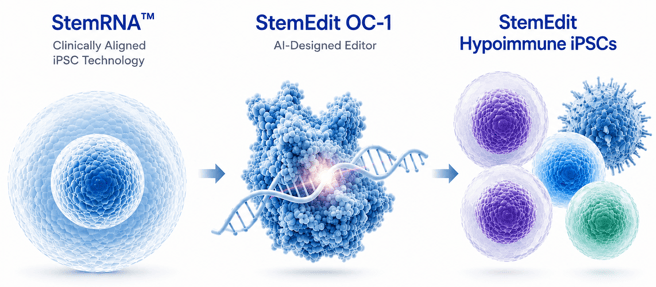
Fig 2. StemRNA™ iPSC technology and StemEdit OC-1 gene editing support the development of engineered hypoimmune iPSCs.
Building on this existing expertise, REPROCELL received a further MSCRF Commercialization Award in 2026 for Generation of Hypoimmune iPSC Seed Stocks for Clinical Applications. Company disclosures report funding of up to $398,535 for the project.
The project also includes development of a modular landing pad platform designed for targeted insertion of genes into genomic safe-harbor loci. This creates a defined engineering framework that could support the development of customized iPSC starting materials for different cell and gene therapy programs.
This progression from established research-grade hypoimmune cell models toward clinically aligned starting materials reflects an important aspect of REPROCELL's broader iPSC strategy: developing technologies that can support programs from early-stage research through translational development.
REPROCELL Recognized at MSCRF’s 20th Anniversary
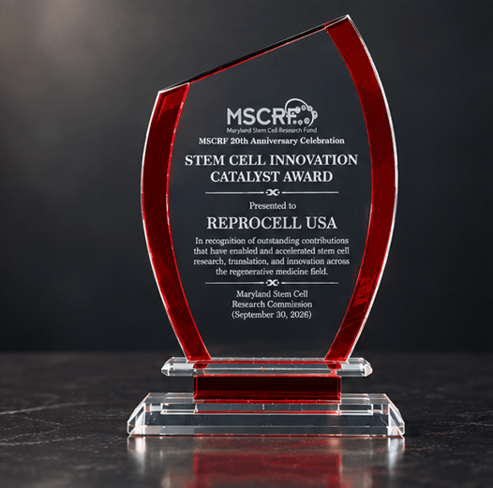
Fig 3. REPROCELL USA received a Stem Cell Innovation Catalyst Award for Innovation at the MSCRF 20th Anniversary Celebration on September 30, 2026.
Against this background, REPROCELL USA joined researchers, companies, clinicians and other industry participants at the MSCRF 20th Anniversary Felicitation Ceremony on September 30, 2026.
At the event, REPROCELL received a Stem Cell Innovation Catalyst Award for Innovation (Figure 3), recognizing its contribution to stem cell research and regenerative medicine. The award was an anniversary recognition and was separate from the competitive funding awards supporting the individual projects described above.
The event marked 20 years of Maryland investment in stem cell research and the development of a regional regenerative medicine ecosystem spanning academic research, biotechnology and manufacturing.
From Clinical iPSC Starting Material to GMP Manufacturing
The MSCRF-supported projects align with REPROCELL’s broader work across the iPSC development pathway: from clinically consented donor material and footprint-free StemRNA™ reprogramming to StemRNA™ Clinical iPSC Seed Clones, StemEdit gene editing and GMP Master Cell Bank manufacturing.
By developing these capabilities within connected workflows, REPROCELL aims to provide researchers and cell therapy developers with defined entry points for both early-stage iPSC research and downstream translational development.
Explore REPROCELL’s solutions for cell therapy developers or contact our scientific team (info-us@reprocell.com) to discuss the starting material, gene editing or GMP manufacturing requirements for your program.
References
-
Maryland Stem Cell Research Fund. Maryland Stem Cell Research Fund 2025 Annual Report. (2025).
-
Maryland Stem Cell Research Fund. Maryland Stem Cell Research Fund 2024 Annual Report. (2024).
-
REPROCELL. REPROCELL Receives Commercialization Award from Maryland Stem Cell Research Fund to Advance Universal, Hypoimmune iPSC Platforms. (2026).
-
REPROCELL. REPROCELL USA Receives Funding from the Maryland Stem Cell Research Fund (MSCRF). (2025).
-
REPROCELL. REPROCELL Launches GMP Master Cell Bank Manufacturing for Clinical iPSCs. (2026).
- Maryland Stem Cell Research Fund. Maryland Stem Cell Research Commission Announces Over $14 Million in Awards to Accelerate Cures. (2023).

About the author
Dayana Ivanova, Marketing and Business Administration, Stem Cells
Dayana combines her strong Medical Sciences background with her growing enthusiasm for digital marketing. She’s passionate about blending her scientific expertise with creative content development, making complex topics accessible and engaging. Outside of work, you’ll find Dayana staying active, traveling, and immersing herself in diverse cultures and cuisines. Connect with Dayana on LinkedIn: linkedin.com/in/dayanaivanova
Subjects we write about
- 3D Cell Culture
- Cell Culture
- Central Lab Services
- Clinical Capabilities
- Disease Modeling
- Drug Discovery
- Gene Editing
- Genomic Services
- GMP
- Human Tissue Samples
- Human Tissue Testing
- IBD
- Life Sciences
- Master Cell Banks
- Neurons
- Oligonucleotide Synthesis
- Pharmacology-AI
- Precision Medicine
- Product Catalog
- Regenerative Medicine
- Respiratory Disease
- Safety Pharmacology
- Skin Disease
- Stem Cells