iPSC-based therapies are at the forefront of next-generation cell therapy, promising scalable and potentially off-the-shelf solutions across a wide range of indications. However, the reality is that most programs underestimate what it actually takes to get from a promising preclinical result to a clinical-grade product.
Success hinges on early alignment between GMP manufacturing, quality control, and regulatory expectations, not as a downstream exercise, but as a core part of development strategy. Clinical-grade iPSC products must meet stringent requirements for identity, purity, potency, genetic stability, and safety, all underpinned by robust well-defined manufacturing processes and quality systems.
Many early-stage programs still operate as if these constraints can be addressed later. However, misconceptions at this stage and uncertainty over what “clinical-ready” truly means often lead to delays, increased costs, or failed clinical translation.
Myth 1: Any Research-Grade iPSC Line Can Become A Clinical Product
Reality: Clinical success is determined by your starting material from day one.
It is a common assumption that research-grade iPSC lines can be adapted for clinical use later. In reality, most such cell lines lack the documentation, traceability, and quality control required for therapeutic applications. Clinical-grade iPSCs do not have to be generated under full GMP from the start, but they must follow GMP principles, regulatorily acceptable processes with defined methods and extensive testing to ensure identity, sterility, genetic stability, and safety. Most importantly, donor eligibility, informed consent, and comprehensive donor blood safety screening must be in place from the beginning. These cannot be fixed later.
REPROCELL addresses this by providing clinically aligned iPSC starting materials from the outset. StemRNA™ Clinical iPSC Seed Clones are GMP-aligned and supported by an active Drug Master File, inclusion in regulatory filings, and IND-approved programs progressing to Phase 3. Each clone includes full donor consent, traceability, and regulatory documentation, along with comprehensive quality control, including karyotyping and WGS-based high-resolution oncogenic profiling.
To support different development strategies, REPROCELL offers:
-
Custom-generated clinical Seed Clones from selected donors
-
Ready-to-use clinical Seed Clones
-
Matched research-grade Pilot Clones for early evaluation
Donors are fully consented for clinical and commercial use, ensuring long-term applicability. Seed clones and any derived pilot clones comply with donor testing, material, and process guidelines under FDA, EMA, and PMDA regulations. They can be used for early functional and process testing, allowing developers to confirm suitability before committing to downstream manufacturing and clinical development. This integrated approach enables developers to start with the right material from day one avoiding the risk of having to restart development due to unsuitable starting material.
Myth 2: Reprogramming Technology has Minimal Impact on Outcomes
Reality: Reprogramming technology is a critical determinant of early clinical success.
The choice of reprogramming method directly influences genomic integrity, safety, regulatory acceptance, and commercial freedom to operate. Even small differences can have major downstream implications for clinical viability and licensing strategy.
REPROCELL addresses this challenge by providing a clinically aligned starting point. Using our proprietary StemRNA mRNA-based reprogramming technology cells are generated without retention of reprogramming vectors, eliminating the need for screening for vector clearance screening and potentially savings weeks on the timeline. In addition, mRNA reprogramming reduces the risk of genomic abnormalities compared to other reprogramming methods. These factors demonstrate that mRNA reprogramming enables footprint-free iPSC derivation while supporting robust genomic integrity, safety, and regulatory compliance from the outset.
Myth 3: Master Cell Banks (MCBs) Are Always Required
Reality: GMP MCBs are not mandatory, but they are often the most practical choice.
While MCBs are not strictly required in every case, they are typically the most logical starting point for product development. A Working Cell Bank (WCB) is a derivative of a MCB used directly in manufacturing. In some workflows, WCBs alone can be sufficient but for programs requiring reproducibility across multiple product batches, starting from a single, well-characterized cell source makes scientific and operational sense.
Regulators emphasize on traceability, consistency, and safety in cell therapy manufacturing. Well-characterized cell banks help meet these expectations by ensuring reproducibility, reducing contamination risk, and supporting scalable production. REPROCELL supports this strategy through flexible cell banking solutions, including GMP MCB and WCB manufacturing. These services span iPSCs, MSCs, and iPSC-derived MSCs (iMSCs), enabling developers to establish robust, well-characterized starting materials tailored to both clinical and commercial manufacturing needs. Developers also benefit from flexibility in manufacturing location, with GMP MCBs produced either at REPROCELL’s U.S. facility or through its European partner, Histocell—an EMA-authorized GMP site—enabling alignment with global regulatory requirements.
Myth 4: GMP Product Acceptance Is Only About Facility Compliance
Reality: GMP is a comprehensive quality system that goes far beyond the facility.
While specialized cleanrooms and equipment are important, GMP manufacturing is a comprehensive quality framework that spans the entire product lifecycle, not just the environment in which a product is made. It includes fully traceable documentation, validated processes, standardized operating procedures, and extensive quality testing. Even small errors in documentation can lead to delays, batch loss, or regulatory setbacks.
REPROCELL’s integrated platform addresses these challenges by combining robust quality systems, standardized operating procedures, and experienced regulatory oversight across the full development workflow, ensuring that products are developed in line with true GMP expectations from the start.
Myth 5: GMP Manufacturing Must Involve Multiple Vendors
Reality: Integrated workflows can reduce risk and accelerate development.
Many cell therapy developers work with multiple providers for cell line development, gene editing, and cell banking. However, transitions between vendors can introduce delays, inconsistencies, and quality risks.
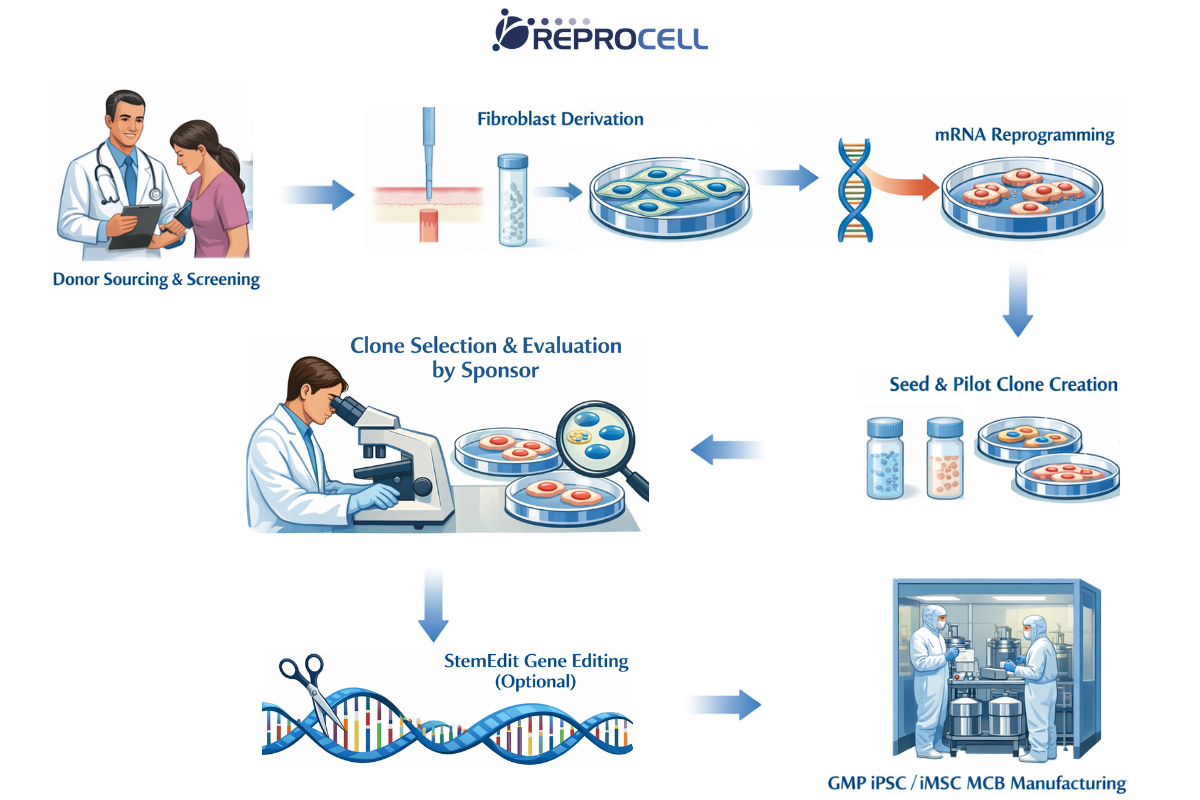
REPROCELL addresses this challenge with an integrated platform combining clinical seed clone generation, StemEdit gene editing, and GMP Master Cell Bank manufacturing a single organization. This approach streamlines development and reduces regulatory complexity for sponsors advancing toward clinical trials.
Moving From Myth to Manufacturing Reality
Developing a cell therapy requires more than promising science: it demands a robust, regulatory-compliant manufacturing strategy. By establishing high-quality starting materials, performing rigorous quality testing, and building GMP-compliant MCBs, developers can reduce risk and accelerate clinical translation.
Through integrated capabilities in clinical seed clone generation, gene editing, and GMP cell banking, REPROCELL supports developers at every stage of this journey, helping turn innovative science into safe, scalable, and clinically viable therapeutic products.

About the author
Dayana Ivanova, Marketing and Business Administration, Stem Cells
Dayana combines her strong Medical Sciences background with her growing enthusiasm for digital marketing. She’s passionate about blending her scientific expertise with creative content development, making complex topics accessible and engaging. Outside of work, you’ll find Dayana staying active, traveling, and immersing herself in diverse cultures and cuisines. Connect with Dayana on LinkedIn: linkedin.com/in/dayanaivanova
Subjects we write about
- 3D Cell Culture
- Cell Culture
- Central Lab Services
- Clinical Capabilities
- Disease Modeling
- Drug Discovery
- Gene Editing
- Genomic Services
- GMP
- Human Tissue Samples
- Human Tissue Testing
- IBD
- Life Sciences
- Master Cell Banks
- Neurons
- Oligonucleotide Synthesis
- Pharmacology-AI
- Precision Medicine
- Product Catalog
- Regenerative Medicine
- Respiratory Disease
- Safety Pharmacology
- Skin Disease
- Stem Cells