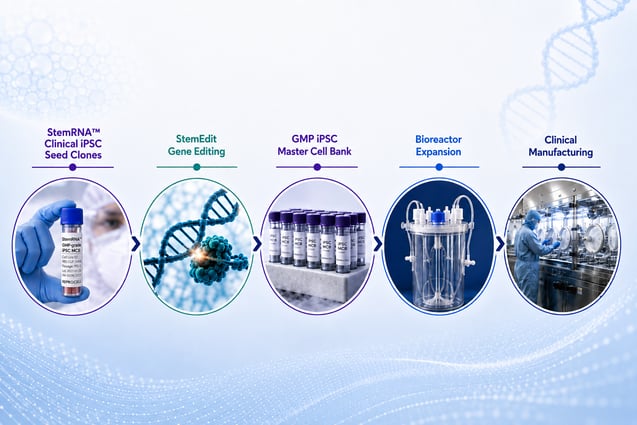
- StemEdit Gene Editing Services
- The Science of OpenCRISPR-1
OpenCRISPR-1: The Science Behind AI-Designed Gene Editing
AI-Enhanced Genome Editing: What’s New
Our latest clinical gene editing offerings combine REPROCELL’s StemRNA™ Clinical iPSC Seed Clones with OpenCRISPR-1™, an AI-designed genome editing system licensed from Profluent Bio (Emeryville, CA, USA) to enable streamlined engineering workflows and ensure a GMP-aligned, traceable, and regulatory-ready platform from the outset.
Reduced off-target edits for safer clinical gene modification
| Feature | Value for Clinical Projects |
|---|---|
| AI-Designed Editor | Proprietary design using generative models for optimized precision beyond natural CRISPR systems. |
| High Specificity | Reduced off-target edits for safer clinical gene modification. |
| Broad Targeting | Enables complex edits, including base changes and immune-evasive designs. |
| Clinical Alignment | Built for translational research and cell therapy applications. |
Advantages of StemEdit Clinical Gene Editing Over Other Caspases
✓Broader targeting scope
✓Improved safety & specificity
✓Can be used with existing Cas9 guides or with customized “designer” editors
✓Platform scalability & democratization
✓Accelerated therapeutic development
How OpenCRISPR-1 Works
AI Meets Gene Editing
OpenCRISPR-1’s design begins with large protein language models (LLMs) pre-trained on millions of naturally occurring CRISPR–Cas sequences to learn the underlying principles of functional genome editors. These models are then fine-tuned specifically on CRISPR–Cas data to guide generation toward proteins with the structural and functional characteristics of Cas9-like nucleases, creating novel gene editors far outside the range of sequences found in nature. From millions of AI-generated candidates, OpenCRISPR-1 was identified for its strong editing activity, on-target efficiency comparable to traditional SpCas9, and reduced off-target effects in human cells, addressing key challenges in precision editing for clinical use. The system also supports fusion with base-editing domains to enable single-base conversions without double-strand breaks, thereby broadening its applicability for therapeutic workflows (Ruffolo et al., 2025).
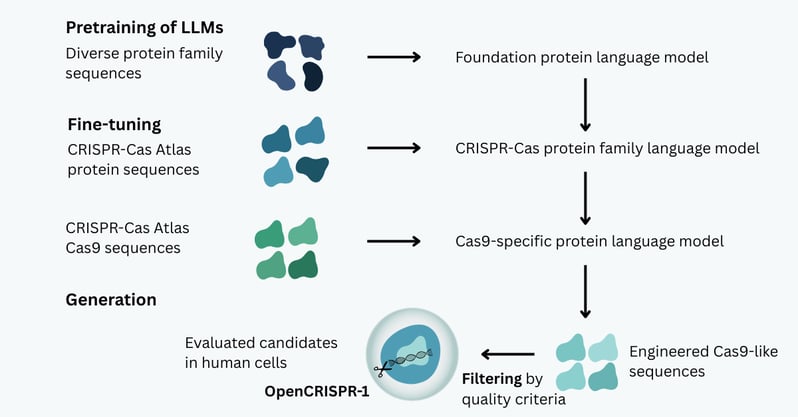
Figure 1. AI-driven design of OpenCRISPR-1. Large language models (LLMs) are first pretrained on a diverse, evolution-wide set of protein sequences - enabling them to learn general constraints of protein evolution and then fine-tuned with CRISPR/Cas (nuclease + nucleic acid) data to generate novel, functional Cas-like proteins such as OpenCRISPR-1.
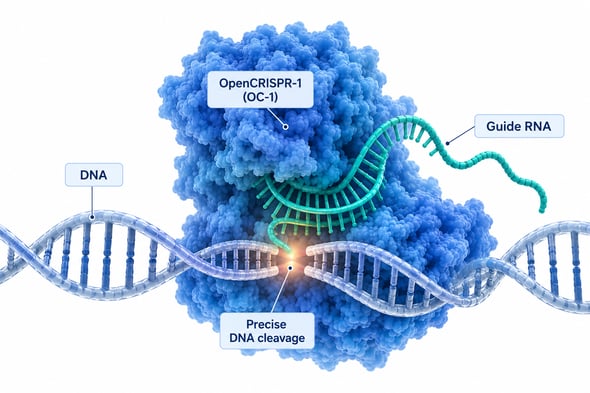
Figure 2. Mechanism of CRISPR-guided DNA targeting. In CRISPR-based editing systems like OpenCRISPR-1, a guide RNA directs the editor protein to a specific DNA sequence, where catalytic domains introduce precise edits. OpenCRISPR-1’s AI-designed architecture maintains this core mechanism while enhancing on-target specificity and reducing off-target activity

REPROCELL & Profluent Bio
Combining AI Protein Design with Clinical Gene Editing Expertise
OpenCRISPR-1 is licensed from Profluent Bio, combining REPROCELL’s clinical gene editing infrastructure with Profluent’s AI-driven protein design capabilities (editor generation and optimization).
See press release, REPROCELL Launches StemEdit: Clinical Gene Editing Services and New iPSC Lines Using AI-Designed Editing System
References
- Evangelou C. OpenCRISPR-1: Generative AI Meets CRISPR. CRISPR Medicine News (2024).
- Ruffolo JA, Nayfach S, Gallagher J, et al. Design of highly functional genome editors by modelling CRISPR-Cas sequences. Nature 645(8080):518-525, (2025).
Contact our experts
Discover more
Gene Editing Services
- GMP iPSC Production Service
- GMP iMSC & MSC Production Service
- iPSC-Derived Exosome Production Service
- GMP iPSC/iMSC MCB Manufacturing – REPROCELL USA
- GMP iPSC/MSC MCB Manufacturing – Histocell (Europe Partner Overview)
- REPROCELL Japan GMP Manufacturing Facility
- For clinical use: Ready-to-use GMP MSCs
Resources
- FAQ: Clinical iPSCs
- FAQ: Clinical MSCs
- FAQ: iPSC-Derived Exosomes
- Making iPSC-Derived Therapeutics a Clinical Reality – our external article in the European Biopharmaceutical Review.
On the REPROCELL blog
Latest in Gene Editing
OpenCRISPR-1: The First AI-Designed CRISPR Editor for High-Precision Gene & Cell Therapy
Discover OpenCRISPR-1 — the first fully AI-designed CRISPR–Cas editor. Built by generative large language model, it enables high-efficiency, high-specificity genome and base editing in human cells. Ideal for cell therapy, stem-cell research, and advanced gene-editing workflows.
16 December 2025
Key Challenges in Clinical iPSC Applications: How REPROCELL Helps You Succeed
Overcome key challenges in clinical iPSC applications with REPROCELL's ethical sourcing, advanced reprogramming, and tailored solutions for reliable, scalable therapies.
12 May 2025
The Therapeutic Advantage of Induced Pluripotent Stem Cells-Derived Mesenchymal Stem Cells (iMSCs)
Discover the clinical benefits and advancements of using induced pluripotent stem cells-derived mesenchymal stem cells (iMSCs) in regenerative medicine and therapeutic applications.
24 February 2025