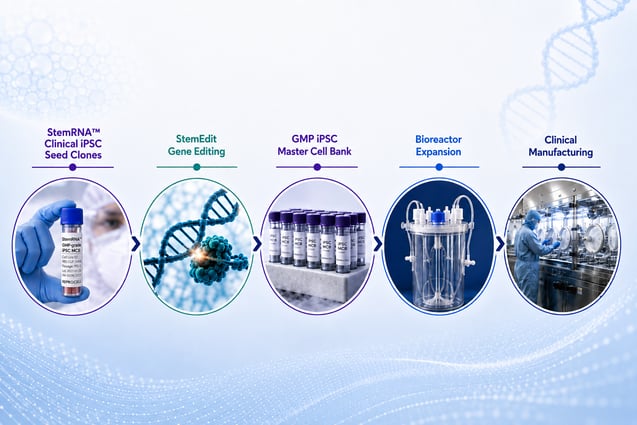
Reduced off-target edits for safer clinical gene modification
| Feature | Value for Clinical Projects |
|---|---|
| AI-Designed Editor | Proprietary design using generative models for optimized precision beyond natural CRISPR systems. |
| High Specificity | Reduced off-target edits for safer clinical gene modification. |
| Broad Targeting | Enables complex edits, including base changes and immune-evasive designs. |
| Clinical Alignment | Built for translational research and cell therapy applications. |
Advantages of StemEdit Clinical Gene Editing Over Other Caspases
✓Broader targeting scope
✓Improved safety & specificity
✓Can be used with existing Cas9 guides or with customized “designer” editors
✓Platform scalability & democratization
✓Accelerated therapeutic development
How OpenCRISPR-1 Works
AI Meets Gene Editing
OpenCRISPR-1’s design begins with large protein language models (LLMs) pre-trained on millions of naturally occurring CRISPR–Cas sequences to learn the underlying principles of functional genome editors. These models are then fine-tuned specifically on CRISPR–Cas data to guide generation toward proteins with the structural and functional characteristics of Cas9-like nucleases, creating novel gene editors far outside the range of sequences found in nature.
From millions of AI-generated candidates, OpenCRISPR-1 was identified for its strong editing activity, on-target efficiency comparable to traditional SpCas9, and reduced off-target effects in human cells, addressing key challenges in precision editing for clinical use. The system also supports fusion with base-editing domains to enable single-base conversions without double-strand breaks, thereby broadening its applicability for therapeutic workflows (Ruffolo et al., 2025).
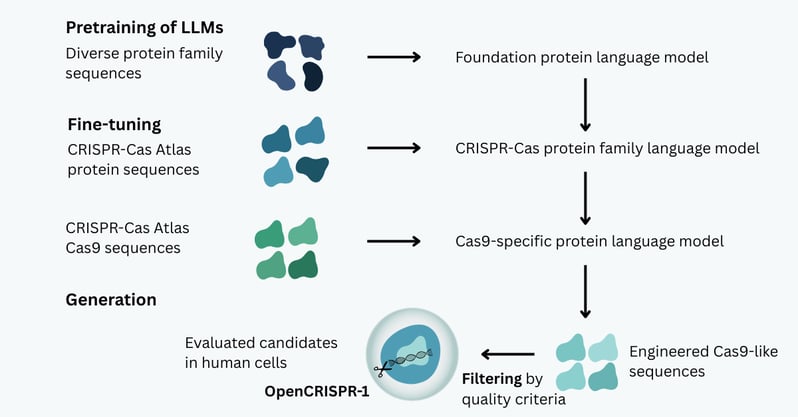
Figure 1. AI-driven design of OpenCRISPR-1. Large language models (LLMs) are first pretrained on a diverse, evolution-wide set of protein sequences - enabling them to learn general constraints of protein evolution and then fine-tuned with CRISPR/Cas (nuclease + nucleic acid) data to generate novel, functional Cas-like proteins such as OpenCRISPR-1.
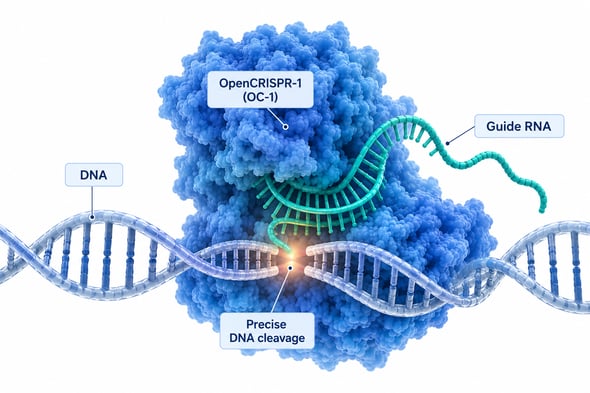
Figure 2. Mechanism of CRISPR-guided DNA targeting. In CRISPR-based editing systems like OpenCRISPR-1, a guide RNA directs the editor protein to a specific DNA sequence, where catalytic domains introduce precise edits. OpenCRISPR-1’s AI-designed architecture maintains this core mechanism while enhancing on-target specificity and reducing off-target activity