Demonstrating Target Engagement of an AhR Modulator in Human-Derived Intestinal Tissues
Background
Activation of the Aryl Hydrocarbon Receptor (AhR) pathway is a key mechanism underpinning epithelial repair and barrier function in inflammatory diseases such as ulcerative colitis (UC). A critical biomarker of AhR activation is the induction of CYP1A1 gene expression, which serves as a direct indicator of pathway engagement.
This case study highlights how REPROCELL’s human tissue platforms—including ex vivo intestinal explants—were used to evaluate CYP1A1 induction by a novel AhR-modulating compound in human-derived tissues.
The Challenge
Developing therapeutics targeting epithelial barrier dysfunction requires robust confirmation of target engagement in human-relevant systems. While in vitro cell models provide early insights, they do not fully capture the complexity of human intestinal tissue, particularly in disease contexts such as ulcerative colitis.
To address this, a study was designed to:
- Assess compound activity directly in fresh human gastrointestinal tissue
- Quantify gene expression responses associated with AhR activation
- Generate translational data supporting relevance to human disease biology
The study utilised human intestinal tissue cultures, where biopsies and supernatants were analysed for cytokine and gene expression changes.
REPROCELL's Approach
Human Tissue Model Systems
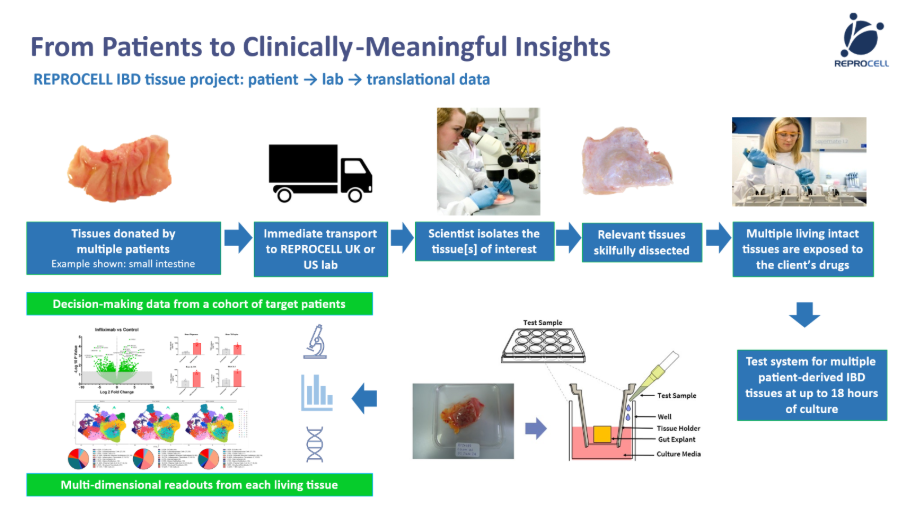
- REPROCELL supported evaluation using clinically relevant human ex vivo intestinal explants derived from surgical residual intestinal tissue
Fresh mucosal biopsies from intestinal tissue donated following surgery were cultured ex vivo under controlled conditions, enabling direct assessment of compound effects on intact epithelial architecture.
Experimental Design
Intestinal explants were:
- Cultured with test compounds under stimulated conditions
- Processed for RNA extraction and RT-qPCR analysis
- Analysed for expression of key genes including CYP1A1 alongside other markers of epithelial function
Multiple concentrations of the test compound were evaluated, allowing assessment of dose-dependent responses in human tissue.
Gene Expression Readouts
CYP1A1 expression was quantified using RT-qPCR following treatment of:
- Human intestinal organoids (over multiple timepoints) (not conducted at REPROCELL)
- Ex vivo intestinal tissue explants (conducted at REPROCELL)
These systems enabled evaluation of target engagement in both controlled 3D epithelial models and intact human tissue environments.
Key Findings
Consistent CYP1A1 Induction Across Human-Derived Models
Treatment of human-derived intestinal systems resulted in robust induction of CYP1A1 gene expression, confirming activation of the AhR pathway in epithelial cells.
- CYP1A1 expression increased in intestinal organoids derived from both healthy and ulcerative colitis donors following compound treatment (not conducted at REPROCELL)
- Induction was observed at multiple timepoints (e.g. 3 and 10 days), demonstrating sustained pathway activation
Dose-Dependent Response in Ex Vivo Tissue Explants
In human intestinal explants:
- CYP1A1 expression exhibited a dose-dependent increase following ex vivo treatment (conducted at REPROCELL)
- This response was quantified as fold-change relative to vehicle-treated controls
Importantly, each data point represented donor-derived responses, highlighting biological consistency across human samples.
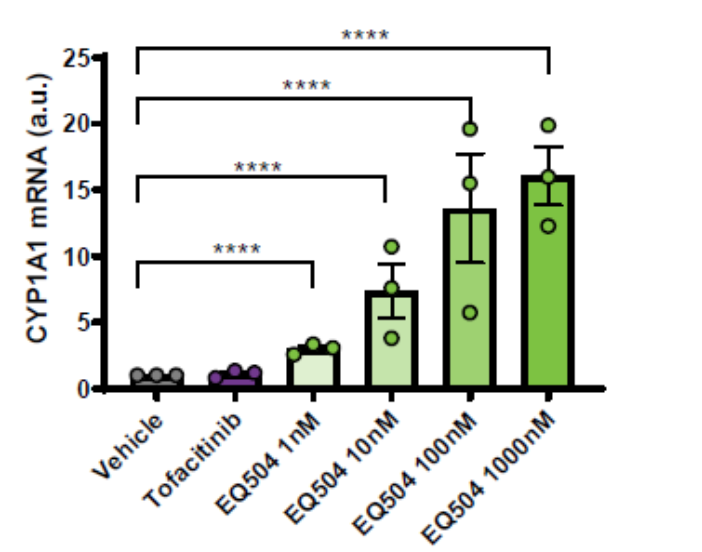
Figure 1. Human intestinal tissues were treated ex vivo with EQ504 for 18 hours. CYP1A1 gene expression was analysed by RT-qPCR. Tofacitinib at 1 mM acted as a control. EQ504 increase CYP1A1 expression in a concentration-dependent manner. Visit the Equillium website for more information.
Validation of Target Engagement in Physiologically Relevant Systems
The observed CYP1A1 induction across:
- Organoid cultures
- Fresh human tissue explants
demonstrated that the compound engaged its intended molecular target in complex, human-relevant epithelial systems, beyond simplified cell line models.
Why This Matters
Translational Confidence
Demonstrating target engagement in human-derived tissues provides stronger translational relevance compared to conventional in vitro assays. By confirming CYP1A1 induction in intact epithelial systems, this study supports the biological activity of the compound in a context that closely reflects patient physiology.
Relevance to Ulcerative Colitis
The use of ulcerative colitis-derived tissue ensures that findings are directly applicable to disease-relevant biology, where epithelial barrier dysfunction and inflammation are central features.
Platform Advantages
REPROCELL’s capabilities enabled:
- Direct testing in fresh human tissue biopsies
- Integration of organotypic and ex vivo models
- Quantitative assessment of gene expression biomarkers
This combination provides a powerful approach for evaluating mechanism of action and supporting early-stage therapeutic development.
Conclusion
This study demonstrates that AhR pathway activation can be robustly measured in human-derived intestinal tissues through CYP1A1 expression, providing clear evidence of target engagement.
By leveraging human intestinal organoids and ex vivo explant models, REPROCELL enabled:
- Confirmation of biologically relevant activity
- Assessment of dose-dependent responses
- Generation of data relevant to human biology
These findings highlight the value of human tissue-based platforms in advancing drug development for inflammatory diseases affecting epithelial barrier function.