CASE STUDY
Investigating Human Cardiac and Vascular Effects of Anti‑Arrhythmic Drugs Using Human Functional Tissues
Background
Cardiovascular safety remains a critical consideration in the development of anti‑arrhythmic therapies, particularly where hemodynamic side effects such as hypotension or impaired cardiac contractility are observed clinically. Anti‑arrhythmic drugs are frequently associated with adverse cardiovascular events, yet the underlying mechanisms driving these effects can be difficult to resolve using animal models alone.
To address this challenge, Pharma researchers commissioned REPROCELL (Biopta) to investigate the direct vascular and cardiac effects of two clinically used anti‑arrhythmic agents—vernakalant and flecainide—using human isolated cardiovascular tissues. The objective was to determine whether observed clinical hemodynamic effects were driven by intrinsic drug activity on human tissues, or by secondary physiological mechanisms.
Study Objective
The aim of this study was to compare the intrinsic vasorelaxant and inotropic effects of vernakalant and flecainide in human isolated vascular and cardiac tissues, at concentrations relevant to clinical exposure. By generating data directly in human tissue, the study sought to improve translational understanding of cardiovascular safety signals observed in patients.
Experimental Approach
REPROCELL conducted functional assays using:
- Human subcutaneous resistance arteries to assess vascular tone
- Human ventricular trabecular muscle preparations to evaluate cardiac contractility
Both tissues were obtained from human donors and studied using established organ bath and muscle contractility systems. Test concentrations of vernakalant and flecainide encompassed free plasma concentrations associated with clinical efficacy in the conversion of atrial fibrillation.
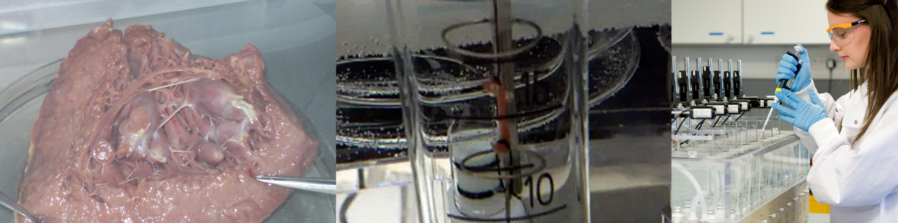
Figure 1. Human fresh isolated tissues donated following surgery or via transplant networks are a valuable tool for pharmacological studies. From the atria or ventricles isolated bundles of cardiac muscle can be dissected (left image) and placed into organ baths (middle image) for measurement of contractile force in the presence of test drugs (right image).
All experimental work described in the associated publication was performed at REPROCELL’s GLP-compliant laboratory in Glasgow, ensuring data quality suitable for translational decision-making.
Key Findings
Vernakalant
- Demonstrated no significant direct effects on human resistance artery tone
- Showed no measurable impact on ventricular muscle contractility across clinically relevant concentrations
These findings indicate that the rare hypotensive events observed clinically with vernakalant are unlikely to be driven by direct vasorelaxant or negative inotropic effects in human tissue, suggesting that secondary or reflex mechanisms may play a role.
Flecainide
- Did not significantly alter vascular tone in human resistance arteries
- Produced a significant reduction in ventricular contractile force at higher concentrations
- Reduced both the rate of force development and relaxation in human ventricular muscle
These results indicate that the hemodynamic effects associated with flecainide in patients are most likely attributable to direct negative inotropic effects on human cardiac muscle, rather than vascular mechanisms.
Outcome and Impact
This study, details of which were published by the Pharma researchers in the Journal of Cardiovascular Pharmacology, provided clear mechanistic insights into the cardiovascular safety profiles of two anti‑arrhythmic therapies by leveraging human functional tissue models. By separating vascular and cardiac effects within relevant human tissue systems, the collaboration enabled:
- Improved understanding of drug‑specific safety liabilities
- Greater confidence in interpreting clinical hemodynamic observations
- Enhanced translational relevance compared with animal-only approaches
The work highlights the value of human tissue–based assays in de‑risking cardiovascular drug development and resolving mechanistic uncertainty earlier in the pipeline.
Why Human Functional Tissue Models?
This collaboration demonstrates how human isolated cardiovascular tissues offer a powerful platform for:
- Disentangling cardiac vs vascular mechanisms
- Supporting safety pharmacology decisions with human‑relevant data
- Bridging the gap between preclinical findings and clinical outcomes