CASE STUDY – NeurAxon Inc.
Demonstrating Functional Vascular Safety of a Selective nNOS Inhibitor in Human Resistance Arteries
Background
NeurAxon Inc. partnered with Biopta Ltd. (now part of REPROCELL) to generate human-relevant vascular safety data supporting the development of selective neuronal nitric oxide synthase (nNOS) inhibitors.
Neuronal nitric oxide synthase (nNOS) is a validated target in neuropathic pain and primary headache disorders, including migraine and chronic tension-type headache (CTTH). However, targeting nitric oxide synthase (NOS) enzymes presents a key safety challenge:
- Off-target inhibition of endothelial NOS (eNOS) can impair endothelium-dependent vasorelaxation
- This may lead to undesirable cardiovascular effects
While in vitro enzyme assays can demonstrate isoform selectivity, they cannot confirm whether endothelial function is preserved in intact human vessels.
The Challenge
NeurAxon required functional evidence to answer critical translational questions:
- Does a selective nNOS inhibitor preserve endothelium-dependent vasorelaxation?
- Can biochemical selectivity translate into functional vascular safety in human tissue?
- Is there any evidence of eNOS inhibition liability under physiologically relevant conditions?
This required a human, functional assay system capable of directly measuring nitric oxide–mediated vascular responses.
Our Approach
REPROCELL (Biopta) assessed eNOS-mediated responses in ex vivo human tissue through our human resistance artery assay (figure 1).
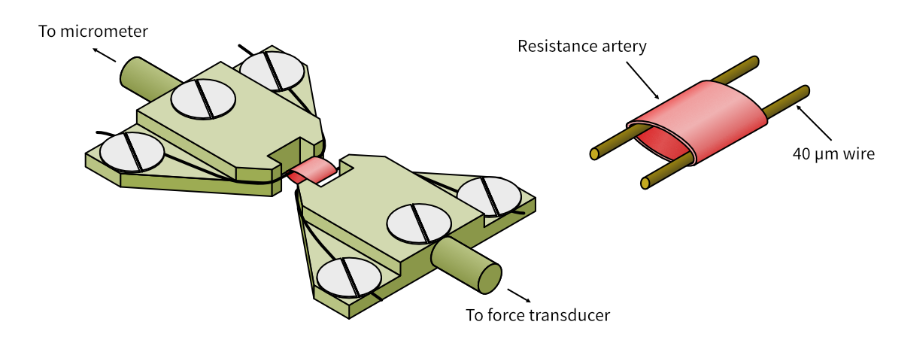
Figure 1. Tiny resistance arteries isolated from samples of human fresh tissue, such as skin, can be used as a sensitive measure of drug-mediated effects on peripheral vascular resistance (PVR), a key determinant of blood pressure. The force detected following contraction or relaxation of the artery in the presence of a test drug indicates the potency and magnitude of the drug effects.
The human resistance artery assay enables:
- Measurement of endothelium-dependent vasorelaxation via acetylcholine (ACh)
- Detection of eNOS inhibition liability, benchmarked against a non-selective NOS inhibitor (L-NAME)
- Mechanistic confirmation using L-arginine rescue
Human resistance arteries were selected as a clinically relevant vascular bed, preserving integrated nitric oxide signalling under near-physiological conditions.
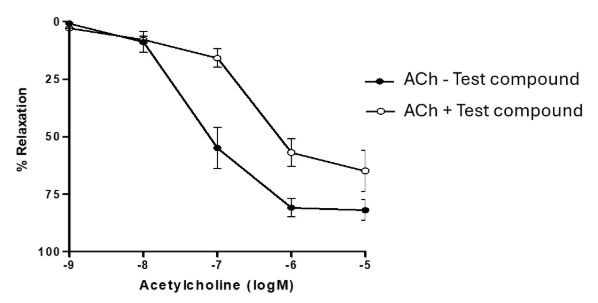
Figure 2. Compounds which inhibit endothelial nitric oxide synthase (eNOS) can reduce responses to endothelium-dependent vasodilators such as acetylcholine (ACh). The graph above shows the relaxant responses of human resistance arteries to increasing concentrations of ACh in the presence (○) and absence (●) of a test drug. In the presence of a test drug found to inhibit eNOS, the relaxation response to ACh was reduced.
Test Compound
The lead molecule, Compound 16, is a 3,6-disubstituted indole derivative developed by NeurAxon. Its in vitro profile indicated strong isoform selectivity with reduced predicted cardiovascular risk. The objective of this study was to confirm whether this selectivity translated into preserved endothelial function in human vessels.
Key Results
Assay Validation (Positive Control)
- L-NAME produced concentration-dependent inhibition of ACh-mediated vasorelaxation
- This effect was reversed by L-arginine, confirming a nitric oxide–dependent mechanism
- These responses validated both tissue integrity and assay sensitivity to eNOS inhibition
Compound 16: Functional Vascular Safety
- No significant inhibition of ACh-induced vasorelaxation at any tested concentration
- L-arginine had no meaningful effect, indicating no underlying NOS inhibition
- No direct contractile or vasoconstrictive effects observed
Together, these findings demonstrated that Compound 16 did not functionally inhibit eNOS in intact human resistance arteries, even at supratherapeutic concentrations.
Translational Insight
This study provided clear functional evidence that biochemical selectivity for nNOS translated into preserved endothelial function, with no detectable vascular liability associated with eNOS inhibition. Furthermore, the use of human ex vivo data enabled early de-risking of potential cardiovascular concerns, supporting more confident progression during drug development.
Impact
Through this collaboration, REPROCELL enabled NeurAxon Inc. to confirm vascular safety in human tissue beyond enzyme-based assays, de-risk potential cardiovascular liabilities at an early stage of discovery, and generate robust mechanistic data to support confident, decision-making and continued development of their selective nNOS inhibitor programme.
Why It Matters
This case study highlights the importance of human ex vivo vascular pharmacology in bridging the gap between molecular selectivity and clinical safety.
By integrating:
- Medicinal chemistry
- Enzyme profiling
- Functional human tissue assays
REPROCELL enabled more confident progression of CNS and pain therapeutics.
Conclusion
Through collaboration with REPROCELL, NeurAxon demonstrated that a highly selective nNOS inhibitor preserved endothelium-dependent vasorelaxation in human resistance arteries.
This human-relevant, mechanistic approach provided decisive safety evidence, supporting the advancement of Compound 16 in neuropathic pain and headache indications.