REPROCELL is pleased to announce the publication of a new research article in Biomaterials Advances, highlighting the potential of chondroprogenitors derived from induced pluripotent stem cells (iPSCs) for cartilage tissue engineering.
The study, led by Dr. Maria Laura Vieri, represents the outcome of a PhD research project at the University of Glasgow, co-sponsored and co-supervised by REPROCELL. As part of this collaboration, REPROCELL provided the human StemRNA™ iPSC line used in the study and iPSC culture training to the research team.
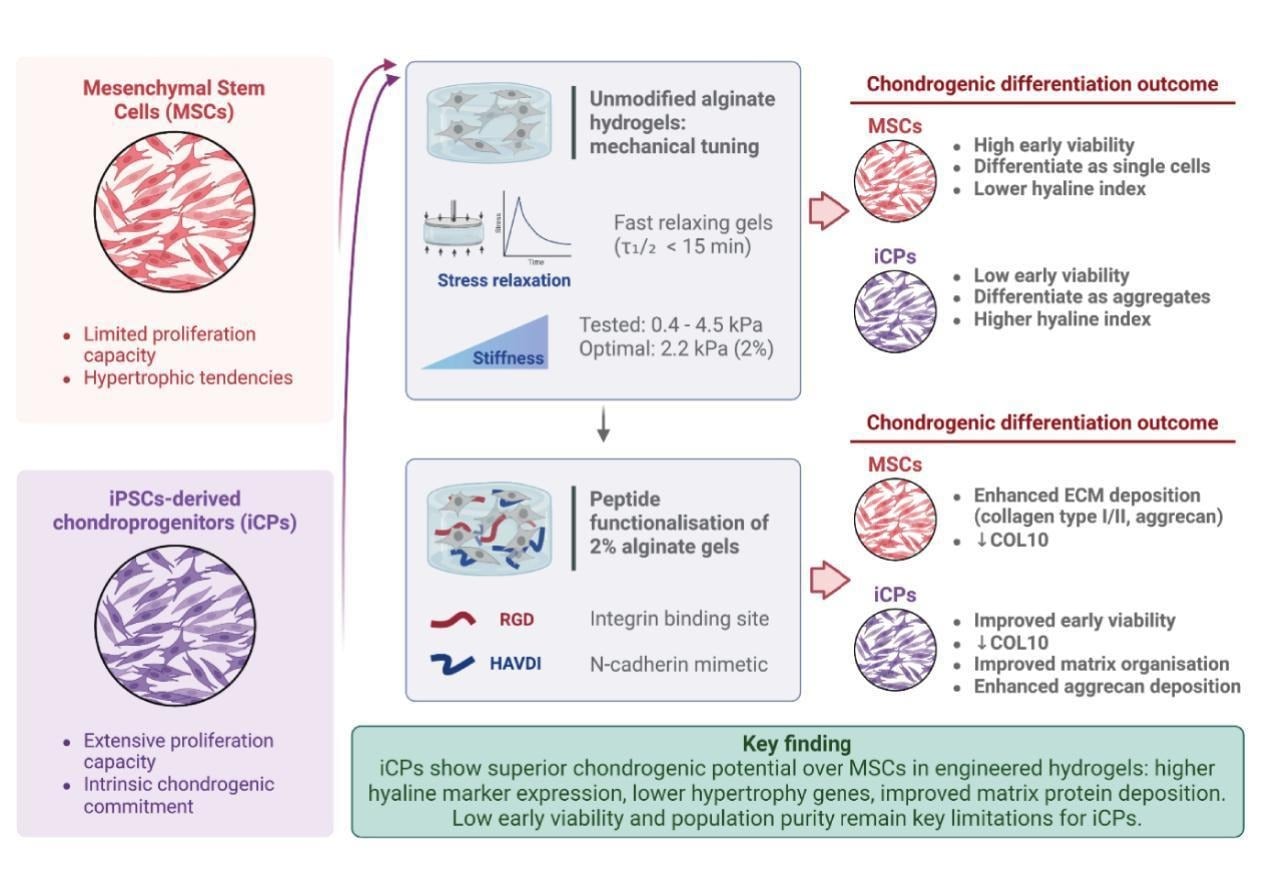
Graphical abstract. Overview of the study comparing iPSC-derived chondroprogenitors and mesenchymal stem cells in alginate hydrogels for cartilage tissue engineering. Reproduced from Vieri et al. (2026), Biomaterials Advances, under the Creative Commons Attribution 4.0 International License (CC BY 4.0). Reproduced without modification.
Exploring Alternative Cell Sources for Cartilage Tissue Engineering
The limited capacity of articular cartilage to regenerate remains a significant challenge in tissue engineering. Although mesenchymal stem cells (MSCs) are widely used in cartilage engineering research, limitations such as donor variability, restricted expansion capacity, and hypertrophic differentiation have encouraged the investigation of alternative cell sources.
The study compared iPSC-derived chondroprogenitors (iCPs) with bone marrow-derived MSCs in three-dimensional alginate hydrogels of varying stiffness and with different biochemical modifications.
Key findings from the study include:
-
Compared with MSCs, iCPs demonstrated characteristics more consistent with hyaline cartilage and lower expression of hypertrophy-associated markers.
-
Modification of hydrogels with HAVDI and RGD peptides partially improved chondroprogenitor viability and promoted the expression of markers associated with hyaline cartilage.
-
Within these peptide-functionalized hydrogels, iCPs generated a uniformly distributed extracellular matrix resembling hyaline cartilage.
These findings support further investigation of iPSC-derived chondroprogenitors for cartilage tissue engineering and modeling. However, improvements in cell population purity and survival following encapsulation remain necessary.
Advancing Stem Cell Research Through Academic–Industry Collaboration
This publication demonstrates how REPROCELL’s iPSC technology and academic–industry collaborations can support the development of innovative approaches to tissue engineering and regenerative medicine.
REPROCELL congratulates Dr. Maria Laura Vieri, Dr. Nikola Kolundzic, and all the co-authors on this achievement and is proud to have supported this research.
Read the full publication:
Vieri, M. L., et al. iPSC-derived chondroprogenitors as a promising cell source for cartilage engineering: A comparison with MSCs in unmodified and peptide-functionalized alginate hydrogels. Biomaterials Advances. (2026).
Corporate news by tag