Despite significant advances in target identification, screening technologies, and computational modelling, the pharmaceutical industry continues to face a major challenge: translating promising preclinical findings into clinical success.1
While many drug candidates demonstrate efficacy in animal models and cell-based systems, a substantial proportion fail during clinical development due to insufficient efficacy, unexpected safety concerns, or an incomplete understanding of human disease biology.2
A striking example of the translational gap can be seen across multiple inflammatory diseases, where therapies that showed promising results in animal models failed to demonstrate the same efficacy in patients. As highlighted in recent reviews of drug development strategies, animal models often capture only selected aspects of human disease and may not reproduce the complex cellular interactions observed in patient tissues. Human-derived biospecimens, including patient biopsies and tissue explants, provide researchers with an opportunity to evaluate therapeutic mechanisms directly within the biological context they are intended to treat.3
At the heart of this challenge lies a simple reality: human disease occurs in human tissue.
As a result, there is growing recognition that incorporating human biospecimens and tissue-based models earlier in the drug development process can improve translational confidence, reduce development risk, and generate more clinically relevant insights.4
The Limitations of Traditional Preclinical Models
Animal models and immortalised cell lines remain valuable tools for investigating biological mechanisms and screening compounds. However, they often fail to fully recapitulate the complexity of human physiology and disease.5
Species-specific differences in receptor expression, immune responses, signalling pathways, and tissue architecture can significantly impact drug responses. Similarly, transformed cell lines may not accurately reflect the cellular heterogeneity or microenvironment present in human tissues.6
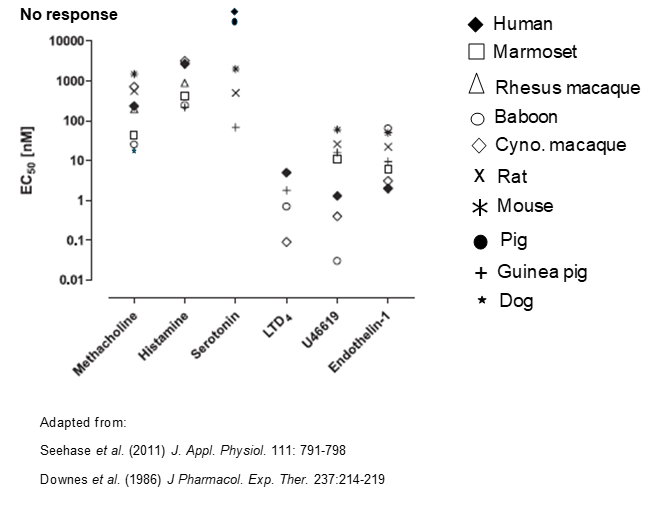 Figure 1. Data adapted from REPROCELL in-house research and published findings in isolated bronchi of various preclinical animal species, shows the potency of bronchoconstrictors varies both by species and mechanism (six key vasoconstrictors tested for their ability to constrict isolated airways), with no preclinical species accurately reflecting human airways.
These limitations can lead to discrepancies between preclinical findings and clinical outcomes, contributing to costly late-stage failures. To address this challenge, researchers are increasingly integrating human-derived biospecimens into translational workflows.
What Are Human Biospecimens?
Human biospecimens encompass a wide range of donated biological materials, including:
- Whole blood
- Peripheral blood mononuclear cells (PBMCs)
- Plasma and serum
- Fresh and cryopreserved tissues
- Disease-specific biopsies
- Primary cells
- Patient-derived organoids and explants
Each biospecimen provides a direct window into human biology and can be used to answer distinct scientific questions throughout the drug discovery and development process.7
Preserving Disease-Relevant Biology
One of the key advantages of human tissue-based research is the ability to study drug responses within a biologically relevant context.
The value of preserving native tissue architecture became particularly evident during the COVID-19 pandemic. Human lung organoids, alveolar models, and lung-on-chip systems were able to reproduce key features of SARS-CoV-2 infection, including epithelial damage, inflammatory responses, and vascular dysfunction. These models provided mechanistic insights that would have been difficult to obtain from conventional cell cultures alone and helped researchers investigate potential therapeutic interventions in systems that more closely reflected human physiology.
For drug developers, this illustrates an important principle: when tissue structure and cell-cell interactions are maintained, researchers gain a more realistic view of how therapies may perform in patients.8
Fresh human tissues retain the complex interactions between multiple cell types, extracellular matrix components, and signalling networks that are often lost in simplified in vitro systems.9
This is particularly important when studying diseases driven by complex cellular interactions, such as:
- Inflammatory bowel disease (IBD)
- Psoriasis and atopic dermatitis
- Fibrosis
- Asthma and chronic respiratory diseases
- Cardiovascular disorders
- Neuroinflammatory conditions
By preserving native tissue architecture and disease-associated pathways, researchers can evaluate therapeutic responses under conditions that more closely resemble the clinical setting.10
Improving Confidence in Target Validation
Target validation is a critical step in drug discovery, yet many targets identified through genomic or animal studies fail to demonstrate clinical relevance.11
Human biospecimens enable researchers to confirm:
- Target expression in patient tissues
- Disease-specific pathway activation
- Cellular localisation of targets
- Variability between patient populations
This information can help determine whether a therapeutic target is genuinely relevant to human disease before substantial development resources are committed.12
When integrated with transcriptomic, proteomic, and functional analyses, human tissue studies provide a more robust foundation for target selection and prioritisation.
Generating Mechanistic Insights
Understanding how a therapeutic candidate exerts its effects is increasingly important for both regulatory submissions and clinical development strategies.
One of the most compelling demonstrations of human tissue models generating mechanistic insight comes from oncology. Patient-derived tumour organoids have been shown to retain many of the genetic, phenotypic, and treatment-response characteristics of the original tumour. Researchers can expose these organoids to multiple therapeutic candidates and observe how different tumour subtypes respond, generating mechanistic evidence that helps explain why some patients respond to treatment while others do not.13
Rather than simply measuring whether a drug works, these models help researchers understand how and why it works—a critical distinction when selecting candidates for clinical development.
Human tissues can be used to investigate:
- Mechanisms of action
- Biomarker responses
- Pathway modulation
- Cellular interactions
- Dose-response relationships
Because these studies are performed in biologically relevant human systems, they often provide mechanistic insights that are difficult to obtain using conventional preclinical models alone.14
These data can support candidate selection, biomarker identification, and patient stratification strategies.
Capturing Patient Heterogeneity
Human disease is inherently heterogeneous.
Patients with the same clinical diagnosis often exhibit substantial differences in molecular pathways, immune responses, and treatment outcomes.
Studies using biospecimens from multiple donors enable researchers to evaluate inter-patient variability and better understand responder and non-responder populations.15
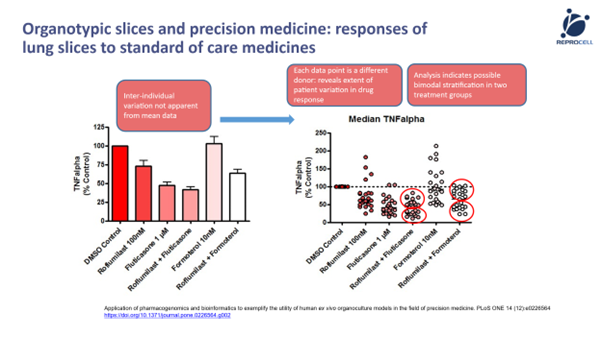
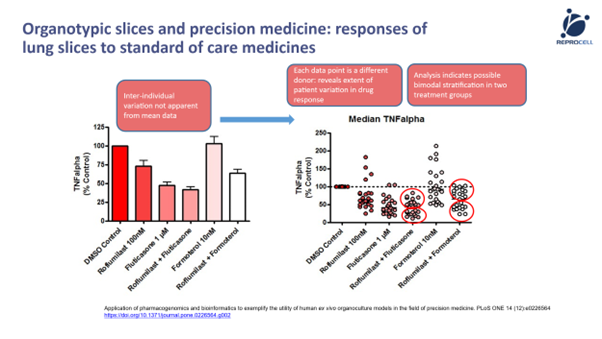 Figure 2. Fresh sections of human lung tissue cultured in vitro retain their ability to respond to common respiratory medicines such as beta-adrenoceptor agonists, phosphodiesterase inhibitors and steroids, as measured by reductions in the inflammatory hormone, TNF-alpha. As occurs clinically, fresh human tissues reflect inter-patient variation in drug responses. The left graph shows the mean data for a cohort of 25 patients, but when the data is plotted as individual patients (right graph, each dot is data from a single patient), the variation is revealed. The planning of precision medicine strategies in preclinical in drug discovery programs is possible using human in vitro/ ex vivo studies.16
This approach supports the development of precision medicine strategies by helping identify:
- Predictive biomarkers
- Patient subgroups
- Differential drug responses
- Potential resistance mechanisms
In therapeutic areas such as IBD, oncology, and immunology, understanding this variability is becoming increasingly important for clinical success.
Supporting Translational Biomarker Development
Biomarkers play a crucial role throughout drug development, from target validation through to clinical trial design.
Human biospecimens provide an opportunity to identify and validate biomarkers directly within clinically relevant systems.
Researchers can assess:
- Cytokine production
- Gene expression signatures
- Protein biomarkers
- Histological changes
- Functional tissue responses
Importantly, these biomarkers can often be tracked from preclinical studies into clinical trials, strengthening translational continuity and improving confidence in clinical endpoints.17
A practical example can be seen in inflammatory diseases, where researchers often monitor cytokines such as TNF-α, IL-6, or IL-17 as indicators of drug activity. If a therapy demonstrates consistent modulation of these biomarkers in human tissue studies, those same markers may later be incorporated into clinical trials to help confirm biological activity in patients.
This creates a stronger translational link between preclinical findings and clinical outcomes, reducing uncertainty as programmes progress through development.
Human Tissue as Part of an Integrated Translational Strategy
Human tissue models are not intended to replace all traditional preclinical approaches. Rather, they serve as a critical translational bridge between discovery and clinical development.
When combined with in vitro assays, computational modelling, and in vivo studies, human biospecimens provide complementary data that can improve decision-making at multiple stages of development.18
An integrated strategy may include:
- Target identification through multi-omics analysis
- Validation in human patient tissues
- Mechanistic studies using fresh explants or primary cells
- Biomarker discovery and verification
- Translation into clinical trial design
This approach allows researchers to generate evidence that is more closely aligned with human biology before advancing candidates into the clinic.
Human Tissue as a Decision-Making Tool
Perhaps the most important contribution of human biospecimens is not simply generating more data, it is generating more actionable data.
A recent shift in drug discovery has been the move from asking whether a compound produces an effect in a model system to asking whether that effect is likely to be relevant in human biology. Human tissues, organoids, and advanced ex vivo models provide a critical layer of evidence that helps answer this question. Reviews of modern human disease models suggest that these systems can improve the clinical relevance of preclinical findings by incorporating human-specific biology, disease mechanisms, and patient variability that are difficult to capture elsewhere.
In practical terms, this means researchers can make more informed decisions about which targets to pursue, which biomarkers to monitor, which patient populations to prioritise, and which therapeutic candidates are most likely to succeed in clinical trials.
Conclusion
As the industry seeks to improve R&D productivity and reduce clinical attrition, human biospecimens are playing an increasingly important role in translational research.
By providing direct access to disease-relevant human biology, fresh tissues, primary cells, and patient-derived samples can help researchers validate targets, uncover mechanisms of action, identify biomarkers, and evaluate therapeutic responses with greater confidence.
Ultimately, moving from biospecimen to insight enables more informed decision-making throughout drug development—helping to bridge the gap between preclinical promise and clinical success.
At REPROCELL, our integrated human tissue platforms provide researchers with access to high-quality biospecimens, disease-relevant models, and translational expertise designed to generate clinically meaningful data and accelerate the development of safer, more effective therapies.
References
1. Chen J, Guo Y, Shao J, Guo M and Zhu X (2025) Target fishing: from “needle in haystack” to “precise guidance”--new technology, new strategy and new opportunity. Front. Pharmacol. 16:1673688. https://doi.org/10.3389/fphar.2025.1673688.
2. Hartung T (2024) The (misleading) role of animal models in drug development. Front. Drug Discov. 4:1355044. https://doi.org/10.3389/fddsv.2024.1355044.
3. Hartung T (2024) The (misleading) role of animal models in drug development. Front. Drug Discov. 4:1355044. https://doi.org/10.3389/fddsv.2024.1355044.
4. Fischer, D.S., Villanueva, M.A., Winter, P.S. et al. Adapting systems biology to address the complexity of human disease in the single-cell era. Nat Rev Genet 26, 514–531 (2025). https://doi.org/10.1038/s41576-025-00821-6.
5. Loewa, A., Feng, J.J. & Hedtrich, S. Human disease models in drug development. Nat Rev Bioeng 1, 545–559 (2023). https://doi.org/10.1038/s44222-023-00063-3.
6. Anjun Jiao, Cangang Zhang, Xin Wang, Lina Sun, Haiyan Liu, Yanhong Su, Lei Lei, Wenhua Li, Renyi Ding, Chenguang Ding, Meng Dou, Puxun Tian, Chenming Sun, Xiaofeng Yang, Lianjun Zhang, Baojun Zhang,
Single-cell sequencing reveals the evolution of immune molecules across multiple vertebrate species,
Journal of Advanced Research, Volume 55, 2024, Pages 73-87, ISSN 2090-1232, https://doi.org/10.1016/j.jare.2023.02.017.
7. Blood and Biospecimens, www.sanbio.nl/blood-and-biospecimens. Accessed 23 June 2026.
8. Loewa, A., Feng, J.J. & Hedtrich, S. Human disease models in drug development. Nat Rev Bioeng 1, 545–559 (2023). https://doi.org/10.1038/s44222-023-00063-3.
9. Peter A. Galie, Paul A. Janmey, Interplay between extracellular matrix mechanics and cell function in mechanobiology, Current Opinion in Biomedical Engineering, Volume 34, 2025, 100589, ISSN 2468-4511,
https://doi.org/10.1016/j.cobme.2025.100589.
10. Lázár, E., Lundeberg, J. Spatial architecture of development and disease. Nat Rev Genet 27, 118–136 (2026). https://doi.org/10.1038/s41576-025-00892-5.
11. Lansdowne, Laura Elizabeth. “Target Identification & Validation in Drug Discovery | Technology Networks.” Technology Networks Drug Discovery, www.technologynetworks.com/drug-discovery/articles/target-identification-validation-in-drug-discovery-312290.
12. Al Diffalha S, Sexton KC, Watson PH, Grizzle WE. The Importance of Human Tissue Bioresources in Advancing Biomedical Research. Biopreserv Biobank. 2019 Jun;17(3):209-212. https://doi.org/10.1089/bio.2019.0039. PMID: 31188626; PMCID: PMC7061295.
13. Loewa, A., Feng, J.J. & Hedtrich, S. Human disease models in drug development. Nat Rev Bioeng 1, 545–559 (2023). https://doi.org/10.1038/s44222-023-00063-3
14. Kenakin, T. Know your molecule: pharmacological characterization of drug candidates to enhance efficacy and reduce late-stage attrition. Nat Rev Drug Discov 23, 626–644 (2024). https://doi.org/10.1038/s41573-024-00958-9.
15. Khare K, Pandey R. Cellular heterogeneity in disease severity and clinical outcome: Granular understanding of immune response is key. Front Immunol. 2022 Aug 22;13:973070. https://doi.org/10.3389/fimmu.2022.973070. PMID: 36072602; PMCID: PMC9441806.
16. Cowan K, Macluskie G, Finch M, Palmer CNA, Hair J, et al. (2019) Application of pharmacogenomics and bioinformatics to exemplify the utility of human ex vivo organoculture models in the field of precision medicine. PLOS ONE 14(12): e0226564. https://doi.org/10.1371/journal.pone.0226564
17. Gromova M, Vaggelas A, Dallmann G, Seimetz D. Biomarkers: Opportunities and Challenges for Drug Development in the Current Regulatory Landscape. Biomark Insights. 2020 Dec 8;15:1177271920974652. https://doi.org/10.1177/1177271920974652. PMID: 33343195; PMCID: PMC7727038.
18. Liangbin Zhou, Jingjing Huang, Cun Li, Qi Gu, Gang Li, Zhong Alan Li, Jiankun Xu, Jie Zhou, Rocky S. Tuan,
Organoids and organs-on-chips: Recent advances, applications in drug development, and regulatory challenges,
Med, Volume 6, Issue 4, 2025, 100667, ISSN 2666-6340, https://doi.org/10.1016/j.medj.2025.100667.
About the author
Ella Cutter, Digital Marketing Manager, REPROCELL Europe
Hailing from an American background in journalism and publishing, she likes to read, run and try new restaurants in her free time. Connect with her on LinkedIn: www.linkedin.com/in/ellacutter.
Subjects we write about
- 3D Cell Culture
- Cell Culture
- Central Lab Services
- Clinical Capabilities
- Disease Modeling
- Drug Discovery
- Gene Editing
- Genomic Services
- GMP
- Human Tissue Samples
- Human Tissue Testing
- IBD
- Life Sciences
- Master Cell Banks
- Neurons
- Oligonucleotide Synthesis
- Pharmacology-AI
- Precision Medicine
- Product Catalog
- Regenerative Medicine
- Respiratory Disease
- Safety Pharmacology
- Skin Disease
- Stem Cells