Quality Control Data of Typical StemRNA™ Clinical iPSC Clones
Morphology, P6+3

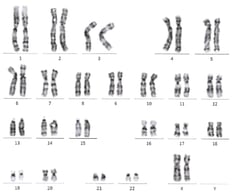
Karyology
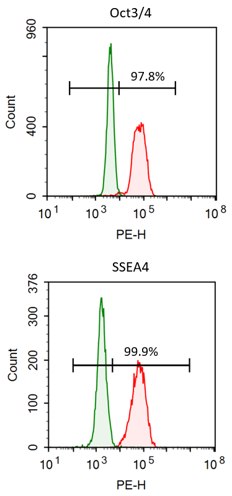
Flow Cytometry Analysis
3-germ Layers Differentiation Potential
Measured by RT qPCR
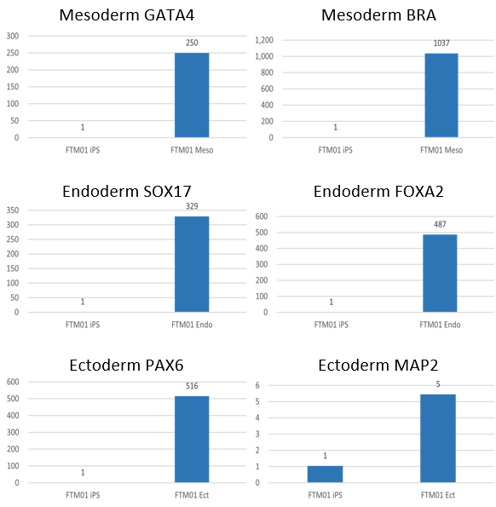
Typical quality control assays of Clinical StemRNA iPSC Lines. Typical quality control assays for Clinical StemRNA™ iPSC lines. To confirm suitability as starting material for clinical programs, each clonal line undergoes comprehensive validation, including cell count, post-thaw viability, sterility and mycoplasma testing, colony morphology and growth assessment, karyotyping, and pluripotency marker expression by flow cytometry. Functional pluripotency is further evaluated through directed differentiation into the three germ layers. Only clones meeting all batch release specifications are advanced to scale-up for GMP Master Cell Bank manufacturing. Data generated in-house.
Efficient Neural Differentiation of StemRNA™ iPSCs
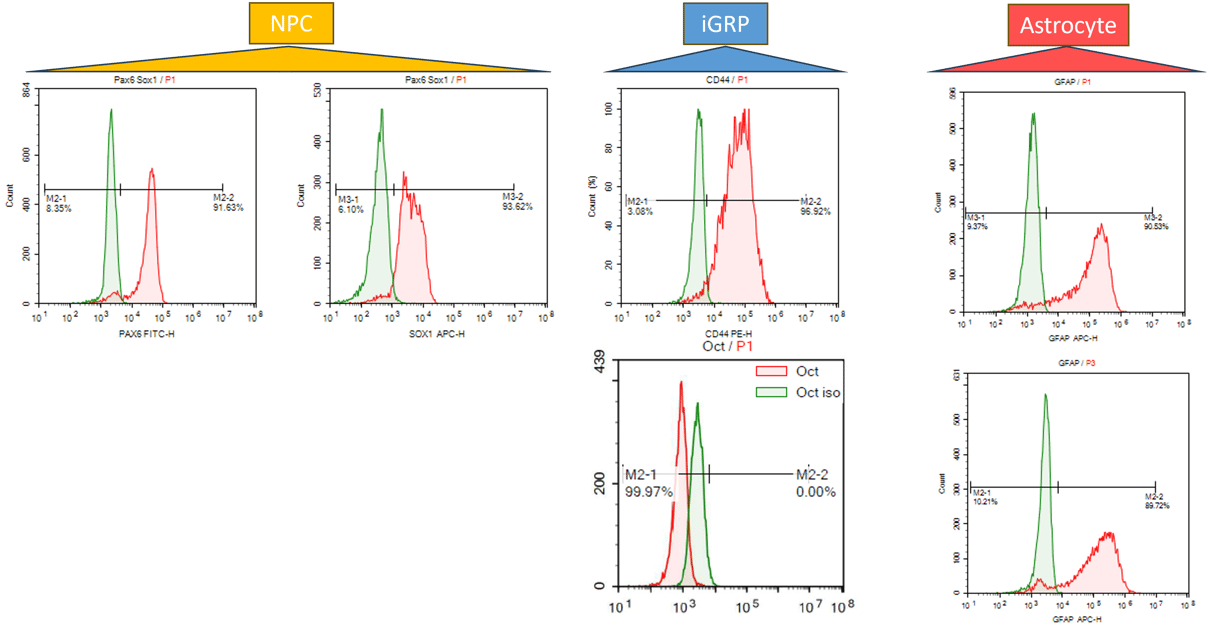
Representative flow cytometry analysis of StemRNA™ clinical iPSC differentiation into neural cell types using rapid and conventional protocols. StemRNA iPSCs were sequentially differentiated into neural progenitor cells (NPCs), induced glia-restricted progenitor cells (iGRPs), and astrocytes. The upper panels show the rapid differentiation protocol using neural stem cell (NSC) medium supplemented with Smoothened agonist (SAG), platelet-derived growth factor-AA (PDGF-AA), and bone morphogenetic protein 4 (BMP-4) for 10 days, while the lower panels show the conventional 21-day protocol using NSC medium supplemented with SAG and PDGF-AA. Stage-specific marker expression is shown in red and corresponding isotype controls in green. Data generated in-house.
Typical iNK Cell Differentiation of
StemRNA™ Clinical iPSC Clones
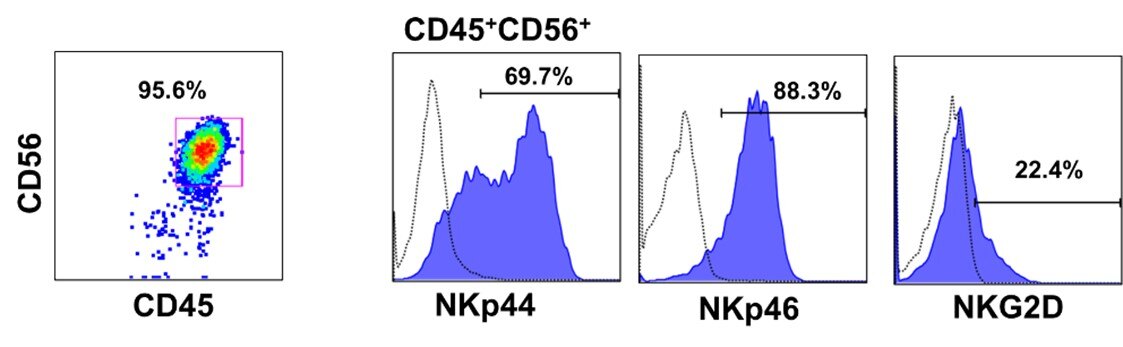
Expression of key NK cell surface markers in iNK cells derived from StemRNA™ clinical iPSC clones REPROCELL's clinical iPSCs were differentiated into iNK cells and characterized by flow cytometry. CD45⁺CD56⁺ NK cells expressed NKp44 (CD336), NKp46 (CD335), and NKG2D (CD314), demonstrating markers typical of mature, functional iNK cells. Data generated in collaboration with the Tokyo Metropolitan Institute of Medical Science, Japan.
On the REPROCELL blog
Latest in Stem Cells

REPROCELL Advances iPSC Innovation with MSCRF Support
REPROCELL has been awarded the Crystal Award for Innovation by MSCRF, highlighting its advancements in iPSC technology and contributions to regenerative medicine.
12 October 2026
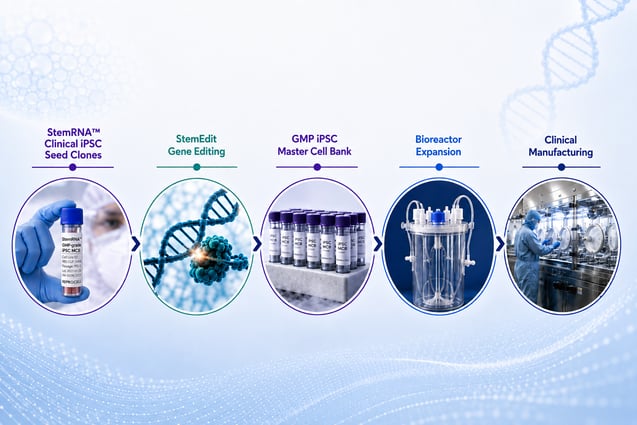
Scaling iPSC Manufacturing: From Cell Line Development to Clinical-Production
Learn how to scale iPSC manufacturing from clinical cell line development and gene editing to GMP cell banking and bioreactor expansion.
27 August 2026

Empowering the Future of Gene Editing with StemEdit OC-1 Protein
Discover the innovative StemEdit OC-1 Protein, a generative AI-designed gene-editing enzyme that enhances genome engineering with improved safety and efficiency.
20 July 2026