Gene Editing Services

StemEdit
Advanced Stem Cell Gene Editing Service

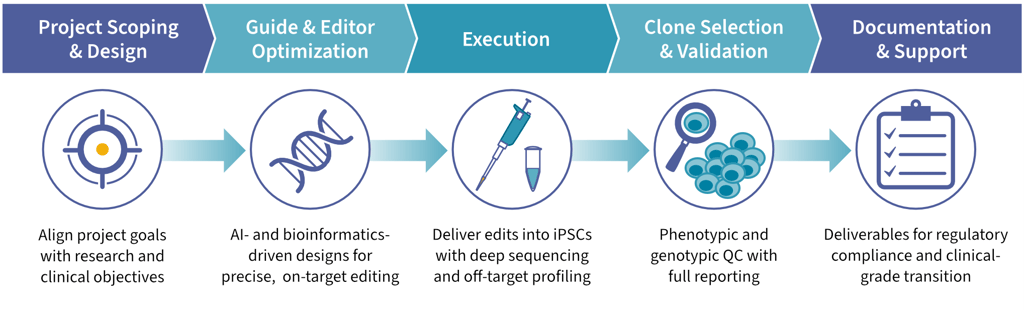
StemEdit provides both research and clinical gene-editing services, enabling precise engineering of stem cells to accelerate your projects and achieve your goals.

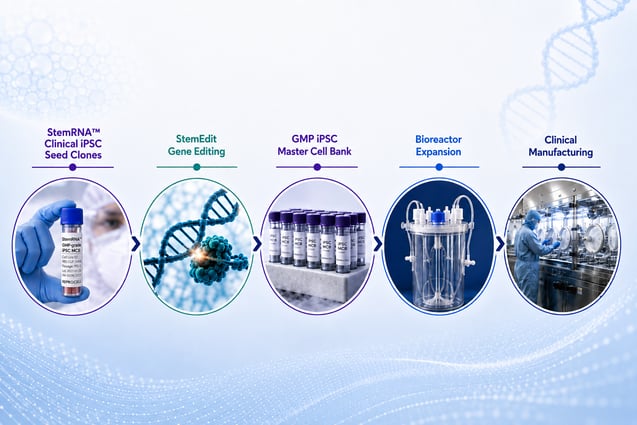
StemEdit is REPROCELL’s advanced genome-editing service, tailored specifically for iPSCs. Whether your goal is to support cutting-edge research or generate gene-edited iPSC lines for clinical applications, our expert team provides high-precision gene modifications designed to meet your exact project requirements.

REPROCELL enables you to obtain the precise genotype required, saving time and resources ahead of large-scale cell bank production. You may provide your own iPSCs or select from our research- and clinical-grade iPSC clones.

Alternatively, we can generate custom iPSC lines, tailored to your specific project goals. Contact us for more details.

High-Precision Genome Editing for Stem Cells

The StemEdit service delivers high-precision gene editing in stem cells, enabling complex modifications early in your project development. Optimized for a variety of nuclease systems (including caspases (Cas enzymes)), StemEdit achieves challenging edits reliably, helping to reduce risk and accelerate progression to downstream cell bank manufacturing.

Examples of genetic modifications include:

  • Knock-in of large gene fragments
  • Knock-in of biallelic mutations
  • Knock-out of multiple genes 
  • Incorporation of reporter or selection genes

Global StemEdit Facilities: Gene Editing in USA & Japan

StemEdit projects can be carried out at either our REPROCELL USA facility in Beltsville, Maryland, or at our REPROCELL Japan GMP Manufacturing Facility, depending on your project’s scope and logistical needs. Choose the location that best matches your timelines, regulatory requirements, and desired throughput. 


REPROCELL Stemgent™ – the stem cell experts

Our broad range of products and services for stem cell scientists are used by leading pharmaceutical and biotechnology companies as well as top academic and government research institutions all around the globe.

Discover REPROCELL Stemgent

Contact us via the inquiry form below

Hypoimmune iPSC Lines from REPROCELL

REPROCELL now offers research-grade hypoimmune human iPSC lines with HLA class I and II knockouts, engineered using our StemEdit™ gene-editing technology.

Currently available lines:

Coming Soon: 

Additional next-generation hypoimmune iPSC lines designed for research and future clinical applications. These lines will feature enhanced editing efficiency and reduced off-target effects, developed using an AI-designed caspase system. Caspases are highly specific proteases that can be engineered for precise genome-modification. Our proprietary platform offers a robust alternative to existing patented caspase systems, enabling high-precision editing while navigating IP limitations .

→ Commercial Launch of StemEdit Hypoimmune hiPSC Lines Generated with Advanced Gene Editing Innovations 

Novel caspase systems with simple licensing structures for gene-edited products remain at the forefront of our current and future offerings, ensuring reliable and widely accessible gene editing solution

Case Study:
HLA Class I/II Knock Out in Clinical Seed Stock iPSCs

One limitation of using iPSCs clinically is immunogenicity caused by Human Leucocyte Antigen (HLA) mismatching, which can reduce the in vivo survival and therapeutic efficacy of these cells.1,2 The immunogenicity of iPSCs can be reduced by disrupting the genes responsible for immune recognition using StemEdit's advanced gene editing platform. One approach is to knock out the B2M (β2 microglobulin) and CIITA (major histocompatibility complex [MHC] II transactivator) genes, creating the basis for the generation of hypoimmune cell lines.  

In humans, the B2M protein is required for the presentation of HLA protein A-G on the cell surface, while CIITA is essential for HLA-II transcription.2,3 Dual knock-out of the B2M and CIITA genes disrupts the presentation of MHC-I/MHC-II proteins in iPSCs, improving their therapeutic potential while maintaining pluripotency.1

Hypoimmune lines updated figure

Role of B2M and CIITA in the regulation of the immune response. B2M regulates the activation of effector T cells. B2M knockouts do not activate effector T cells, leading to a reduced immune response. CIITA regulates the expression of the HLA-II complex. Knockout of CIITA leads to a reduced expression of HLA-II, and a reduced immune response.

References

  1. Wang X et al. Diminished expression of major histocompatibility complex facilitates the use of human induced pluripotent stem cells in monkey. Stem Cell Research & Therapy 11:334 (2020).
  2. Xu H et al. Targeted Disruption of HLA Genes via CRISPR-Cas9 Generates iPSCs with Enhanced Immune Compatibility. Cell Stem Cell 24 pp566-578 (2019).
  3. Deuse et alHypoimmunogenic derivatives of induced pluripotent stem cells evade immune rejection in fully immunocompetent allogeneic recipientsNature Biotechnology 37 pp 252–258 (2019).

REPROCELL offers B2M and/or CIITA knockout iPSC lines as research-grade hypoimmune models, with the option to produce the corresponding clinical-grade edited line once your research evaluation is complete.

Workflow for Clinical Gene Editing

Below is our workflow for generating B2M and CIITA double knockout iPSCs, including phase-contrast images of REPROCELL's Seed Stock iPSC at each stage.

iPSCsiPSC line
arrow-blue-rightarrow-blue-down
DNA manipulation plastic modelGene editing CIITA & B2M
arrow-blue-rightarrow-blue-down
B2M CIITA knockout iPSC ineB2M/CIITA knockout iPSC line

Creating The Basis for Hypoimmune Clinical iPSCs by B2M/CIITA Double Knock-out

HLA expression was confirmed at the protein level by flow cytometry in iPSC lines with with B2M and CIITA double knockouts. Because Class II HLA expression is regulated post-differentiation, Class II levels were assessed in macrophages differentiated from iPSCs (right: anti-HLA-DR antibody). Both Class I and II HLA expression is suppressed in the B2M/CIITA knockout line, demonstrating that REPROCELLs StemEdit genome editing technology can generate iPSCs designed to minimize immune rejection.

Contact us if you have any requests using the inquiry form below.

StemEdit B2M/CIITA knockout iPSCs provide a powerful, immune-evasive foundation for the development of next-generation cell therapy products.

Clinical Stem Cells - B2M CIITA Knock Out Macrophages

HLA Class I and II expression in B2M/CIITA double knock-out iPSCs. HLA expression was measured by flow cytometry in unedited parental iPSC line and after knock-out of B2M and CIITA genes. Expression of HLA I and II is suppressed in B2M/CIITA knockout lines. Results indicate that the generation of iPSC for the purpose of suppressing an immune rejection is successful with StemEdit.

(A.) HLA Class I expression was measured in the parental iPSC-derived macrophages by flow cytometry.

(B.) Undifferentiated iPSCs (“Parental iPSCs”) do not express HLA II. Expression of HLA Class II occurs only in cells post differentiation. Expression of HLA II gene HLA-DR was therefore measured in iPSC-derived macrophages.


Find Out More About StemEdit

If you are interested in finding out more about REPROCELL's StemEdit Clinical Gene Editing Service, please make an inquiry using the form below. Our stem cell experts will be happy to arrange a free consultation to discuss your project in more detail.

For further information about our clinical iPSC services, please refer to our Clinical iPSC FAQ page.
 

Contact our experts