Qkine Application Note 01
Generation of a Full Thickness Human Skin Equivalent Using Alvetex® Scaffold and Qkine® Growth Factor Supplements
Download this application note as a PDF (1.9 MB)
A collaborative study between Durham University, REPROCELL Europe, and Qkine.
Correspondence: info@reprocell-europe.com
Introduction
The skin is a complex, multi-layered organ that forms an integral barrier to protect against physical, chemical and pathogenic challenges. Structurally, the skin is organized into two main tissue compartments: the epidermis, a stratified epithelium predominantly comprised of keratinocytes, and the dermis, a supportive and structural connective tissue layer enriched in extracellular matrix and fibroblasts [1].
Bioengineered human skin equivalents are an important academic, clinical, and industrial tool. They represent a viable alternative to traditional in vitro 2D cell cultures and in vivo animal models, both of which often fail to emulate human anatomy and physiology. In accordance with the principles and guidance from organizations such as the National Centre for the Replacement, Refinement and Reduction of Animals in Research (NC3Rs), and the European Union (Cosmetics regulation EC No 1223/2009), there is a drive to move away from animal-based models for pre-clinical compound assessment [2, 3]. As such, the need for physiologically relevant models is imperative to further dermatological research. However, due to the cellular and structural complexity of human skin, it is highly challenging to build robust and reproducible in vitro models that accurately mimic native tissue biology.
REPROCELL’s Alvetex® Scaffold provides an advanced platform for constructing bioengineered skin models that negates the use of exogenous synthetic or animal derived extracellular matrix components. Alvetex® is a highly porous, inert polystyrene membrane with an architecture that supports natural cell infiltration and proliferation, whilst enabling 3-dimensional (3D) nutrient diffusion. This unique construct enables dermal fibroblasts to grow within a 3D configuration where they deposit de novo ECM and form a dermal equivalent (DE) that is structurally and biochemically comparable to native human skin. This technology is utilized by REPROCELL for the generation of REPROSKIN™, a commercially available, robust and reproducible full thickness skin model. Human primary keratinocytes are seeded onto the apical surface of the dermal equivalent, forming a collagen-IV-enriched basement membrane at the dermal-epidermal junction. Keratinocytes proliferate, differentiate, stratify and cornify to form a multi-layered epidermal tissue compartment with distinct stratum basale, stratum spinosum, stratum granulosum and stratum corneum layers, thereby recapitulating the in vivo architecture of native human skin [4]. To support cell viability, growth, differentiation and maturation, REPROSKIN™ is cultured in specific growth medium, supplemented with recombinant cytokines and growth factors.
Qkine® are a specialist recombinant protein manufacturer producing completely animal origin free highly bioactive growth factors and cytokines, including the only commercially available animal origin free TGF-ꞵ1. With guaranteed consistency in lot-to lot bioactivity, high purity and sterility Qkine growth factors are ideal for the culture of complex 3D tissues.
Here we describe a collaborative study between REPROCELL Europe and Qkine, designed to evaluate the combined application of Alvetex Scaffold Technology and high-purity recombinant growth factors optimal skin model generation and reproducibility.
Method
Generation of a Full Thickness Human Skin Equivalent
Alvetex® Scaffold 12-well inserts presented in a 6-well plate were prepared for seeding following subsequent washes in 70% ethanol, sterile PBS, and culture medium (10 ml per well). Primary human dermal fibroblasts (HDFn; p4-p7) were seeded onto the insert membrane within 100 µl of maintenance medium 1, at a seeding density of 0.5 × 10⁶ fibroblasts per insert; cells were incubated for 2 hours within a humidified incubator at 37°C, 5% CO2 to promote cell adhesion to the scaffold. Inserts were subsequently submerged in culture medium 1 (10 ml per well) and maintained for a further 18 days; culture medium was removed and replenished every 3-4 days. Dermal equivalents were supplemented with Qkine TGF-ꞵ1 PLUS™ (transforming growth factor beta 1; Qk010) to aid de novo ECM deposition.
At day 19 of HDFn culture, culture medium 1 was removed from each well. Primary human epidermal keratinocytes (HEKn; p4) were seeded onto the apical membrane of the scaffold insert within 200 µl of maintenance medium 2, at a seeding density of 1.3 × 10⁶ keratinocytes per insert; cells were incubated for 2 hours within a humidified incubator at 37°C, 5% CO2 to promote cell adhesion to the dermal equivalent. Models were subsequently submerged in culture medium 2 (10 ml per well) and maintained for 48 hours.
To promote keratinocyte differentiation and stratification, models were raised to the air-liquid interface (ALI) at day 3 of keratinocyte culture. Culture medium 2 was completely removed from the basolateral and apical compartment and each insert transferred into the Alvetex well insert holder and deep petri dish (AVP015-2; AVP015-10), using the middle hanging position; 3 models can be accommodated per dish. Culture medium 3 was added to the basolateral compartment of the model inserts (30 ml per dish). Models were subsequently maintained for a further 14 days in culture prior to experimental manipulation; culture medium was removed and replenished every 3-4 days. Cultures were later harvested and processed for downstream analysis. Full thickness human skin equivalents were supplemented with Qkine KGF (keratinocyte growth factor; Qk046) to support keratinocyte viability and differentiation.
Culture Medium Specifications
- Maintenance Medium 1 (complete fibroblast medium): Dulbecco’s Modified Eagle Medium (DMEM) supplemented with 10% v/v FBS, 100 U/ml Penicillin/Streptomycin and 2 mM L-Glutamine (Thermo Fisher Scientific, Loughborough, UK).
- Maintenance Medium 2 (complete keratinocyte medium): Gibco™ Epilife™ Medium with 60 µM CaCl2 supplemented with 1% v/v Gibco™ Human Keratinocyte Growth Supplement (HKGS) and 100 U/ml Penicillin/Streptomycin (Thermo Fisher Scientific).
- Culture Medium 1 (DE medium): complete fibroblast medium, supplemented with 100 µg/ml ascorbic acid (Sigma Adrich, Dorset, UK), and 5 ng/ml TGF-ꞵ1 PLUS™ (Qkine; Qk010).
- Culture Medium 2 (FTS medium): complete keratinocyte medium, supplemented with 100 µg/ml ascorbic acid, 140 µM CaCl2 (Sigma Aldrich) and 10 ng/ml KGF (Qkine; Qk046).
- Culture Medium 3 (FTA medium): complete keratinocyte medium, supplemented with 100 µg/ml ascorbic acid, 1.64 mM CaCl2 and 10 ng/ml KGF (Qkine; Qk046).
RESULTS
TGF-ꞵ1 PLUS™ Facilitates Dermal Equivalent
Formation The dermal equivalent was first established following culture of primary human dermal fibroblasts with the Alvetex Scaffold membrane for 19 days. Models were supplemented throughout with Qkine recombinant TGF-ꞵ1 PLUS™ (Qk010) to support fibroblast proliferation and de novo ECM deposition. Histological analysis by hematoxylin and eosin (H&E) staining revealed extensive fibroblast infiltration and uniform distribution throughout the scaffold membrane (Figure 1A). Fibroblasts remained viable throughout the culture period, and adopted an elongated, spindle-like morphology.
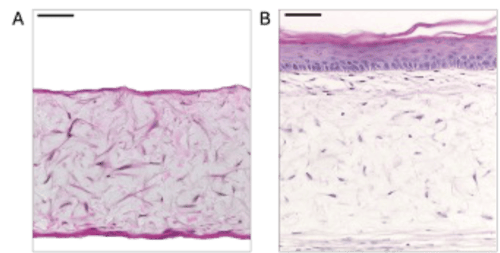
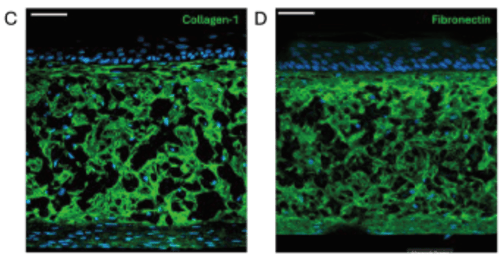 Figure 1. TGF-ꞵ1 PLUS™ supplementation supports extracellular matrix deposition and facilitates dermal-epidermal compartmentalization in full thickness skin equivalents. Representative H&E micrographs of dermal (A) and full thickness (B) equivalents, supplemented with Qkine TGF-ꞵ1 PLUS™ throughout the first 19 days of fibroblast culture. Representative immunofluorescent micrographs for collagen-1 (C, green) and fibronectin (D, green) depict substantial extracellular matrix deposition within the dermal compartment of full thickness skin equivalents. Nuclei were counterstained with Hoechst 33342 (blue). Scale bars = 50 µm.
Primary human epidermal keratinocytes were later seeded onto the apical membrane of the dermal equivalent and cultured for a further 16 days. H&E staining confirmed that the dermal equivalent provided sufficient mechanical and biochemical support to sustain an overlying epidermal tissue compartment, thereby forming a full thickness human skin equivalent (Figure 1B). Immunofluorescent staining for dermal matrix markers, collagen-I and fibronectin, revealed that dermal fibroblasts supplemented with Qkine recombinant TGF-ꞵ1 PLUS™ (Qk010), deposited endogenous, de novo, extracellular matrix components within the scaffold membrane (Figure 1C, Figure 1D).
To assess the bioactivity of Qkine TGF-ꞵ1 PLUS™ (Qk010), in relation to alternative supplier products, we quantified total collagen deposition within dermal equivalent constructs. Despite media supplementation at an equivalent concentration, TGF-ꞵ1 PLUS™ upregulated collagen synthesis within human dermal fibroblasts, and enhanced ECM deposition within the scaffold construct (Figure 2). As such, we show that Qkine TGF-ꞵ1 PLUS™ can be employed to enhance 3D tissue model formation.
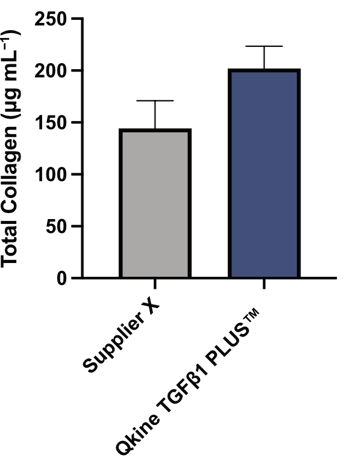
Figure 2. Total collagen deposition within DE is greater in models cultured with TGF-ꞵ1 PLUS™, relative to a competitive supplier. Dermal equivalents were harvested at day 19 of fibroblast culture and the total collagen content assessed via hydroxyproline quantification (Quickzyme, Leiden, Netherlands). Models cultured with Qkine TGFꞵ1 PLUS™ contained a higher collagen content relative to those cultured with TGF-ꞵ1 from an alternative supplier, when tested at the same concentration.
KGF Supplementation Supports Epidermal Differentiation and Maturation
Following keratinocyte seeding onto the dermal compartment, models were maintained in growth medium supplemented with KGF (FGF-7; Qk046). H&E staining highlighted the successful formation of a multi-layered epidermal compartment with distinct basal, differentiating, and cornified keratinocyte strata, overlying the dermal equivalent (Figure 3A). Discrete localization of keratin-14 expression within the basal keratinocytes, and distinct upregulation of keratin-10 expression within the subsequent suprabasal layers further confirmed the formation of an organized and well-differentiated epidermal tissue compartment (Figure 3B).
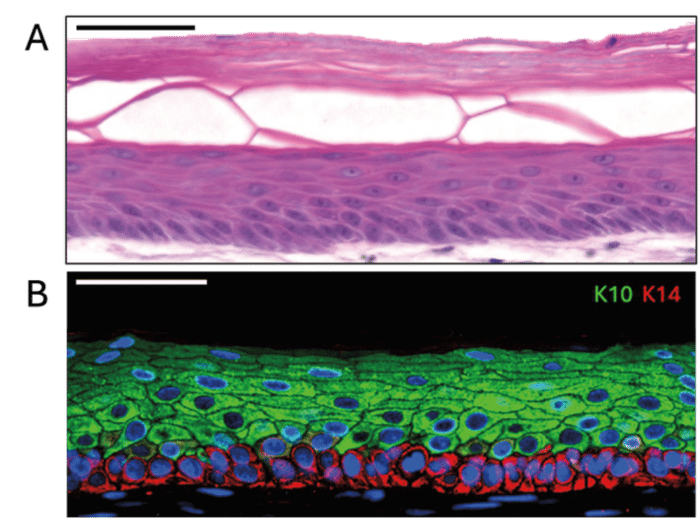
Figure 3. KGF supplementation supports keratinocyte stratification and differentiation. (A) Representative H&E micrographs depicting the epidermal compartment of a full thickness skin equivalent, cultured with Qkine KGF. (B) Representative immunofluorescent micrographs for keratin-10 (K10; green) and keratin-14 (K14; red) revealed specific localization of intermediate filament expression. Nuclei were counterstained with Hoechst 33342 (blue). Scale bars = 50 µm.
Transepidermal water loss measurements were recorded from the apical surface of full thickness skin models to objectively evaluate integral barrier function, following KGF (FGF-7; Qk046) supplementation. TEWL values were in line with published data for native human skin, emphasising the physiological relevance of this model system (Figure 4) [5].
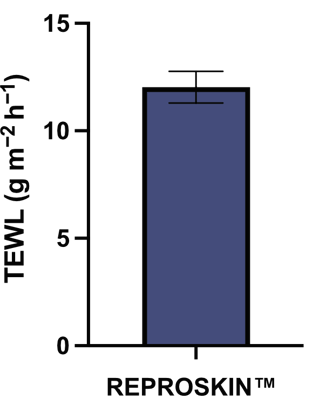
Figure 4. Full thickness skin equivalents generated using Qkine supplements and growth factors form an integral epidermal barrier. Transepidermal water loss (TEWL) measurements were recorded using a VapoMeter probe (Delfin Technologies, Kuopio, Finland) from the apical surface of the epidermal compartment. Values were comparable to that of native human skin.
CONCLUSION
Supplementation of REPROSKIN™ throughout the model build using Qkine’s high-purity and precisely defined growth factors successfully supported cellular differentiation and tissue organization. While TGF-ꞵ1 PLUS™ supplementation enabled dermal compartment formation, KGF (FGF-7) facilitated keratinocyte proliferation and stratification. As such, this collaboration describes a valuable in vitro platform for academic, industrial and commercial skin research applications.
REFERENCES
[1.] Zaidi Z and Lanigan SW. Skin: Structure and Function. 2010, Springer London. p. 1-15. doi: 10.1007/978-1-84882-862-9_1
[2.] Burden N et al. Pioneering better science through the 3Rs: an introduction to the national centre for the replacement, refinement, and reduction of animals in research (NC3Rs). J Am Assoc Lab Anim Sci, 2015. 54(2): p. 198-208. PMID: 25836967
[3.] Filaire E et al. Alternative in vitro models used in the main safety tests of cosmetic products and new challenges. International Journal of Cosmetic Science, 2022. 44(6): p. 604- 613. doi: 10.1111/ics.12803
[4.] Roger M et al. Bioengineering the microanatomy of human skin. Journal of Anatomy, 2019. 234(4): p. 438-455. doi: 10.1111/ joa.12942
[5.] Green M et al. Transepidermal Water Loss (TEWL): Environment and Pollution—A Systematic Review. Skin Health and Disease, 2022. 2(2). doi: 10.1002/ski2.104